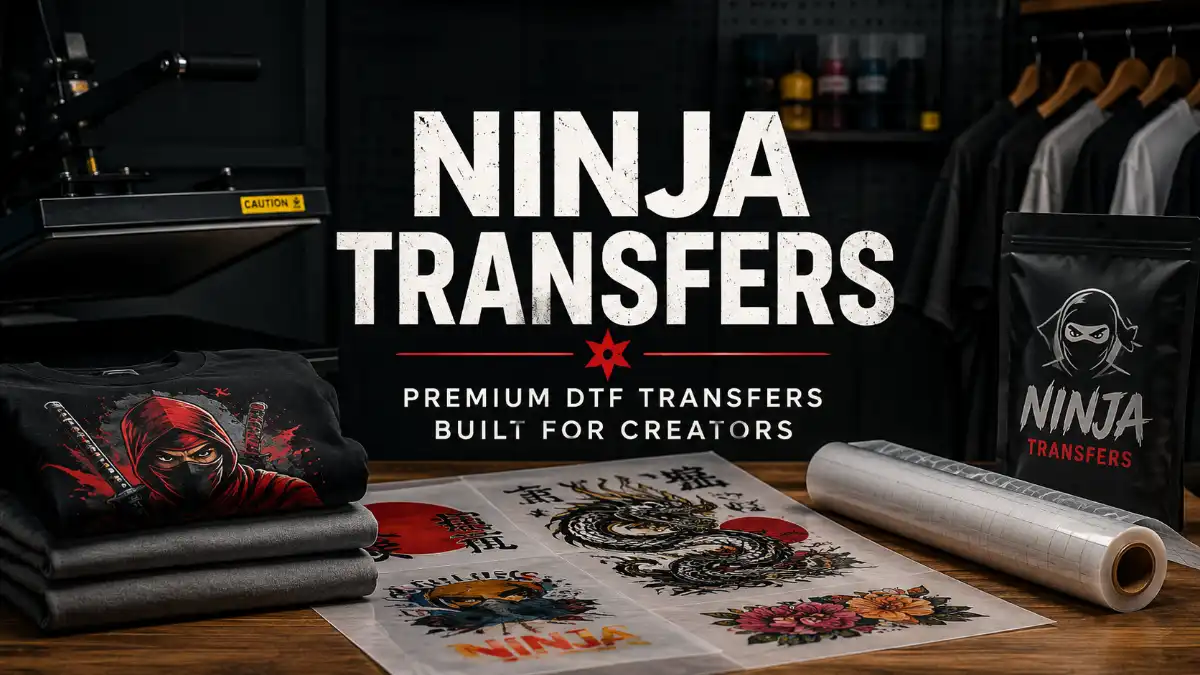
Ninja Transfers provides ready-to-press Direct-to-Film (DTF) transfers for apparel decorators, small businesses, creators, and hobbyists who want full-color designs without operating a DTF printer. Buyers can order individual custom DTF transfers by size, create layouts with a gang sheet builder, or upload print-ready gang sheets; the company advertises no minimum order quantity or art fees.
The right choice depends on the artwork, garment type, order volume, turnaround needs, and the actual cost per finished item—not simply the cost of a transfer sheet.
What Ninja Transfers Is Best For
Ninja Transfers is most useful for projects that require detailed, full-color artwork on a variety of garment colors and common fabrics. DTF transfers are heat-applied graphics that work well for small runs, multicolor designs, branded apparel, team wear, event shirts, and customized merchandise.
Typical applications include:
- Left-chest logos, full-front graphics, sleeve prints, and neck labels
- Branded uniforms and staff apparel
- Small-batch merchandise, gifts, and creator drops
- Team names, player numbers, and event-specific designs
- Print shops that want to outsource transfer production
- Multi-design jobs that can be efficiently arranged on gang sheets
The company states that its transfers can be applied with a heat press, Cricut-style press, or household iron. For commercial work, a dependable heat press is the better choice because it gives more consistent heat and pressure across every garment.
Choosing the Right DTF Order Format
Choose the order format based on how many designs you need and whether you can prepare a print-ready layout.
| Order format | Best for | Main benefit | Consideration |
| DTF transfers by size | One-off designs or a few separate graphics | Straightforward sizing and ordering | Less efficient if many small graphics are needed |
| Gang sheet builder | Multiple logos, labels, or small designs | Helps use sheet area efficiently | Layout must leave room for cutting |
| Upload a gang sheet | Experienced decorators with finished artwork | Full control over the final layout | File errors can affect the complete order |
| UV DTF transfers | Smooth, hard goods such as drinkware and packaging | Applied without a heat press | Not a replacement for apparel DTF |
Ninja Transfers offers individual transfers by size, a gang sheet builder, and uploaded gang sheets. It lists AI, PNG, and PDF among the accepted formats, with vector files preferred for logos and detailed artwork.
- Read more: Ninja Transfers
When the Gang Sheet Builder Makes Sense
A gang sheet combines multiple graphics on one large transfer sheet. It is most valuable when an order includes several small designs: left-chest logos, sleeve prints, youth-size graphics, neck labels, or artwork for different customers.
Use the gang sheet builder only when the sheet can be filled thoughtfully. Keep practical spacing between designs, avoid placing essential details too close to the edge, and verify each design’s physical dimensions before checkout. A logo that looks appropriately sized on screen may be too large or too small once pressed onto a garment.
For example, a clothing brand could combine back prints, left-chest logos, and a few extra logo marks on one sheet. The extra marks may later be used for samples, hats, tote bags, or replacements.
Print Quality: What to Check Before Ordering
Print quality starts with the artwork file. Ninja Transfers describes its transfers as capable of fine detail, bright white ink, full-color printing, and strong wash durability, but a first-order sample remains the most reliable way to judge color, feel, and adhesion for a particular garment or brand.
Before ordering, review the following:
- Resolution: Raster artwork should be created at final print size and at least 300 dpi.
- Vector artwork: AI or PDF files are usually best for logos, line art, and lettering because they preserve sharp edges when resized.
- Transparent backgrounds: Remove unwanted boxes, shadows, and background colors before uploading.
- Small text: Avoid very thin lettering and tiny detached details that may be difficult to reproduce or press cleanly.
- Color expectations: Screen colors do not always match printed colors. Test brand-critical colors, gradients, and skin tones on a physical garment.
- White underbase: DTF’s white ink helps artwork show on dark garments, but semi-transparent effects may need special preparation.
A web image can appear sharp on a phone screen but still print softly at garment size. If the original artwork is small, compressed, or copied from social media, request a better file before placing a large order.
How to Order Custom DTF Transfers
Ordering custom apparel transfers is straightforward, but a few checks can prevent expensive reprints.
- Choose individual transfers, the gang sheet builder, or an uploaded gang sheet.
- Upload the final artwork at the intended print size.
- Confirm design placement, sheet size, quantity, and cutting requirements.
- Check that production and shipping time fit the customer’s deadline.
- Place a small test order for new artwork, color-sensitive logos, or resale products.
- Press one test garment before producing the full run.
Ninja Transfers states that expedited orders ship within 24–48 hours, but production and delivery time can vary by order volume, destination, shipping method, and carrier conditions. Confirm the available delivery estimate at checkout for deadline-sensitive work.
Pressing DTF Transfers Correctly
For its DTF transfers, Ninja Transfers lists 310°F / 155°C at medium pressure for 12–15 seconds, followed by a five-second repress. Follow the current instructions included with the order, particularly when working with specialty garments or a different press style.
Avoid These Heat-Press Mistakes
- Pre-press the garment briefly to remove moisture and wrinkles.
- Use a firm, level pressing surface to prevent weak edges.
- Keep seams, zippers, collars, and thick pockets from creating uneven pressure.
- Follow the specified peel method rather than relying on settings used for another transfer brand.
- Test polyester, performance fabrics, nylon, and coated garments first for scorching or dye migration.
- Inspect the finished press before packing, washing, or producing the remainder of the order.
Heat, time, and pressure work together. Increasing one setting does not reliably compensate for poor pressure or an incorrect pressing surface.
Pricing and DTF Wholesale Considerations
The advertised cost of a sheet is only one part of the job cost. Ninja Transfers advertises certain products from $0.02 per square inch, but the final price depends on size, quantity, product choice, promotions, and shipping.
A useful calculation is:
Transfer cost per finished garment=transfer total+shipping+waste allowanceusable prints
Transfer cost per finished garment=
usable prints
transfer total+shipping+waste allowance
For DTF transfer wholesale or repeat purchasing, consider:
- How much of the gang sheet is usable printed area
- Whether the order includes spare transfers for pressing errors or replacements
- Shipping, rush fees, taxes, garment cost, labor, and packaging
- Reorder consistency for repeat logos and brand colors
- Whether production timing fits the business’s fulfillment schedule
The lowest price per square inch is not necessarily the lowest cost per sellable garment. Efficient layouts and reliable turnaround usually matter more.
Shipping and Deadline Planning
Ninja Transfers promotes fast delivery and says that some orders may arrive as soon as the next day, depending on the order and shipping service. These timelines should be treated as conditional rather than guaranteed.
For launches, events, and client deadlines, allow time for artwork corrections, production, carrier delays, a test press, garment decoration, quality control, and replacements. Ordering early is generally less costly and less risky than relying on rush shipping after artwork changes.
Is Ninja Transfers a Good Fit?
Ninja Transfers can be a practical option for buyers who want no-minimum custom DTF transfers, online gang sheet ordering, and ready-to-press apparel graphics without managing DTF equipment. It is especially relevant for small brands, decorators, creators, and print shops that need flexible order quantities.
It may be less suitable for projects needing exact Pantone matching, specialty screen-print effects, embroidery-like texture, or decoration methods that become part of the garment rather than sit on its surface. In those situations, compare physical samples and total production costs with screen printing, DTG, embroidery, sublimation, or other decoration methods.
Frequently Asked Questions
Ninja Transfers DTF transfers are ready-to-press graphics used for T-shirts, hoodies, sweatshirts, tote bags, workwear, and other compatible textiles. The artwork is printed onto a specialized film, then applied with heat and pressure. This approach is useful for detailed, full-color designs, small quantities, dark garments, and projects that would be impractical to screen print. For resale apparel, test the transfer on the exact garment before completing the full order.
A commercial heat press is not strictly required, but it is the best option for repeatable results. Ninja Transfers says its transfers can be applied with a heat press, Cricut-style press, or household iron. An iron may be suitable for a personal project, but it is difficult to maintain even pressure and accurate temperature across a design. Businesses and high-volume decorators should use a heat press with reliable temperature, pressure, and platen coverage.
Vector artwork, such as AI or PDF, is usually preferred for logos, lettering, and clean line art because it scales without becoming pixelated. Ninja Transfers also accepts PNG and JPG files and recommends raster files at 300 dpi or higher. Upload artwork at the intended physical print size and use a transparent background where appropriate. Avoid screenshots, low-resolution web images, and heavily compressed graphics, since they may produce soft edges or visible pixelation.
A gang sheet builder can lower the cost per design by arranging multiple graphics on one transfer sheet. It is useful for left-chest logos, sleeve prints, neck labels, youth artwork, and small orders with several designs. Savings depend on efficient use of space. Large blank areas, oversized gaps, and poor planning reduce the benefit. Measure each design, leave cutting room between graphics, and add extras only when they are likely to be used for future garments or replacements.
DTF transfers are commonly used on cotton, polyester, and fabric blends. Polyester requires more caution because some garments may scorch or experience dye migration under heat. Test the exact garment color and style before pressing a full order, especially for performancewear, dark polyester, red garments, or low-cost blanks. Use the transfer supplier’s current instructions and do not assume the same settings will work for every fabric.
Ninja Transfers states that its transfers have been tested through 100 machine washes on a cotton garment under specific test conditions. Real-world durability still depends on accurate pressing, the garment material, detergent, wash temperature, drying method, and normal wear. To protect custom apparel transfers, turn the garment inside out, wash in cool water when practical, avoid bleach directly on the design, and do not iron over the printed area.
DTF transfers are designed for textiles and are applied to garments with heat and pressure. UV DTF transfers are adhesive decals generally intended for smooth hard surfaces, such as drinkware, bottles, packaging, and compatible plastics. The two products serve different purposes: choose DTF for apparel and UV DTF for appropriate hard goods. Always test UV DTF on the target surface before selling finished products, since adhesion can vary by coating, texture, and material.
Ninja Transfers says expedited orders ship within 24–48 hours, and certain orders may arrive as soon as the next day. Actual arrival time depends on when the order is placed, artwork readiness, production capacity, selected shipping service, destination, and carrier performance. For a customer deadline, leave enough time for production, shipping, a test press, full garment decoration, and a contingency plan if a replacement is needed.
They can suit a small apparel business or print shop that wants to outsource transfer production instead of operating a DTF printer. No-minimum ordering can help with samples, prototypes, and small client jobs, while gang sheets can improve the economics of repeated designs. Before committing to wholesale-scale production, place a sample order, document press settings, calculate landed cost per usable print, and check whether repeat orders meet expectations for color and size consistency.
Stop production and verify the press temperature, time, pressure, peel method, and pressing surface against the instructions supplied with the transfer. Make sure seams, zippers, thick collars, and uneven garment areas are not preventing even pressure. Press a second test transfer on the same garment before changing settings across the entire order. If the problem continues, keep photos, order details, and the affected transfer so the supplier can review the issue and help identify the likely cause.
