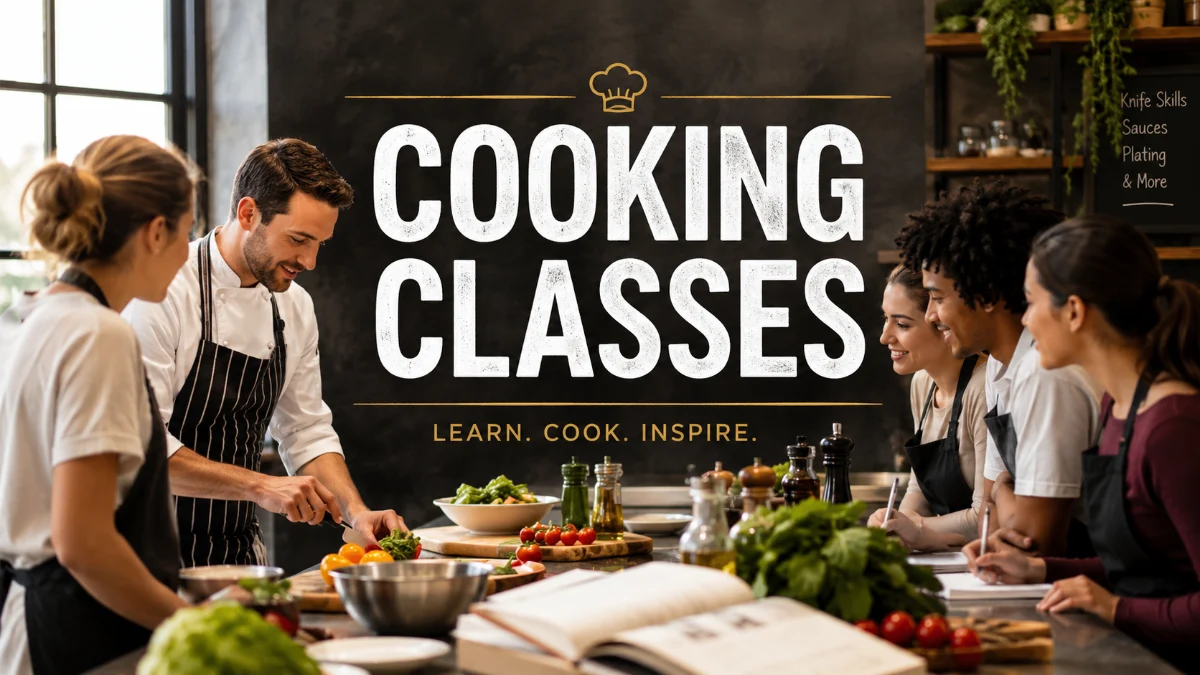
Cooking classes can help you gain practical kitchen skills, explore a favourite cuisine, plan a memorable date, or give someone an experience-based gift. The best option depends on what you want to learn, how much individual guidance you need, your budget, and whether you prefer an in-person workshop or online cooking classes.
For most people, a hands-on session with a clear skill focus offers the best online of learning and enjoyment. Before booking, check whether participants actually cook, how many people share each workstation, what the price includes, and whether the class suits your experience level.
| Your goal | Recommended class type | Why it fits | Check before booking |
| Learn essential kitchen skills | Beginner hands-on class | Builds confidence with chopping, seasoning, cooking methods, and timing | Confirm that students cook rather than only watch |
| Plan a date night | Couples or themed workshop | Creates a shared activity with a meal or cuisine focus | Check whether the price is per person or per couple |
| Master one dish or technique | Specialty workshop | Provides focused practice in areas such as pasta, baking, sushi, or barbecue | Expect narrower skill coverage than a fundamentals class |
| Get individual feedback | Private lesson | Allows the instructor to adapt the pace and menu to your needs | Compare minimum booking requirements and additional charges |
| Learn at home | Live or recorded online class | Provides convenience and a familiar kitchen environment | Check ingredient, equipment, and replay requirements |
| Prepare for a food-service career | Culinary school or professional program | Offers structured, career-oriented culinary training | Consider tuition, schedule, qualifications, and career goals |
| Buy a gift | Gift card or one-time experience | Lets the recipient choose a date or preferred class | Review expiry dates, transfer rules, and booking conditions |
Best Cooking Class Types Compared
Cooking Classes for Beginners
Cooking classes for beginners should focus on techniques that carry over to everyday meals, rather than only completing one recipe. A well-designed introductory class helps you understand what to do, why it works, and how to repeat it at home.
Look for classes that teach:
- Knife safety and basic cutting techniques
- Heat control and cookware selection
- Seasoning and flavour balance
- Preparing vegetables, proteins, grains, sauces, or simple meals
- Recipe reading and mise en place
- Food safety, storage, and kitchen organisation
Choose a class labelled “beginner,” “introductory,” “fundamentals,” or “no experience required.” A smaller hands-on class can make it easier to ask questions and receive feedback while you cook.
Couples Cooking Classes
Couples classes are designed as shared experiences rather than formal training. They often centre on enjoyable, approachable menus, including handmade pasta, pizza, sushi, bread, desserts, regional dishes, or cocktail-friendly meals.
They work well for date nights, anniversaries, birthdays, engagement celebrations, and double dates. The value comes from participating together, not just eating the finished food.
Before booking, confirm whether:
- Tickets are sold per person or per couple
- You will work together or at separate stations
- The class includes a meal after cooking
- Drinks are included, available to purchase, or not offered
- The class is genuinely hands-on
- The provider has flexible rescheduling options
Pasta Making Classes and Specialty Workshops
Pasta making classes, baking classes, sushi workshops, barbecue sessions, and cuisine-specific lessons are ideal when you want to improve one skill in depth. These culinary workshops often combine a clear end result with practical techniques you can use at home.
For example, a pasta workshop may teach dough consistency, kneading, rolling, shaping, filling, and sauce pairing. A baking class may focus on dough development, measuring, oven control, decoration, or troubleshooting common problems.
Specialty lessons are especially useful if you already cook basic meals and want a focused challenge. However, they are not always the best starting point for someone who has never used a knife confidently or cooked independently before.
Read more: Cooking Classes
Private Cooking Lessons
Private lessons offer more personal instruction than a group class. They may take place in a teaching kitchen, a chef’s home, your own home, or through a live video session.
A private format may suit:
- Beginners who want unhurried, individual guidance
- Families learning together
- Small groups celebrating a special occasion
- People with dietary requirements
- Home cooks working on a specific technique
- Learners who want a customised menu or pace
Private sessions usually cost more than group workshops. Providers may charge per person, set a flat event fee, require a minimum number of guests, or bill separately for ingredients and travel. Read the full price details before confirming your booking.
Online Cooking Classes
Online cooking classes can be live, recorded, subscription-based, or private. They are a practical option if you want to learn from home, avoid travel, or revisit a lesson at your own pace.
| Online format | Best for | Main advantage | Consider before enrolling |
| Live group class | Learners who enjoy scheduled, interactive lessons | You can ask questions during the session | Feedback may be limited in large groups |
| Live private class | Learners who want personal support | The instructor can adapt to your pace and goals | Usually costs more than group sessions |
| Recorded course | Busy or self-directed learners | You can pause, replay, and practise repeatedly | You cannot receive immediate correction |
| Membership platform | People exploring multiple cuisines or skills | Access to a broader lesson library | Instructor quality and course depth can vary |
For a live cook-along class, review the ingredient and equipment list well before the start time. Many online providers expect participants to supply their own ingredients, knives, cookware, and standard kitchen tools. Some live classes are not recorded, so do not assume a replay will be available unless it is clearly stated.
How Much Do Cooking Classes Cost?
Cooking class prices vary by city, format, duration, instructor, cuisine, class size, venue, ingredient quality, and included extras. A recorded online course, an in-person group workshop, and a private chef-led event serve different needs and should not be compared by ticket price alone.
| Class format | Typical price level | Best for | Main factors affecting cost |
| Recorded online course | Lower-cost | Flexible, self-paced learning | Course length, access period, and feedback |
| Live online group class | Budget to mid-range | Interactive learning at home | Ingredient cost, class length, and group size |
| In-person group class | Mid-range | Beginners, social learners, and gifts | Venue, ingredients, duration, and hands-on time |
| Premium chef-led workshop | Mid-range to high-end | Food enthusiasts and special occasions | Chef, menu, venue, drinks, and premium ingredients |
| Private cooking lesson | Higher-cost | Personalised teaching and small groups | Instructor time, minimum spend, travel, and groceries |
| Professional culinary program | Major investment | Career-focused learners | Tuition, supplies, equipment, and program duration |
Instead of relying on a single “average” price, compare the complete value of the session. Ask whether the listed fee includes ingredients, equipment, recipe cards, a meal, beverages, taxes, service charges, gratuity, take-home food, and access to online recordings.
A lower-priced demonstration may be right for inspiration, while a slightly higher-priced hands-on workshop may offer more useful practice. Private lessons can deliver personalised coaching but may carry a minimum spend or separate ingredient costs.
How to Find Cooking Classes Near You
Searching only for “cooking classes near me” can produce a broad mix of results. Add your location and objective to find better matches.
Use search phrases such as:
- “[City] cooking classes for beginners”
- “[City] couples cooking class”
- “[City] pasta making classes”
- “[City] baking classes”
- “[City] kids cooking classes”
- “[City] private cooking lessons”
- “[City] corporate cooking class”
- “[City] Indian cooking class”
- “[City] vegetarian cooking class”
You may find local options through culinary schools, chef-led teaching kitchens, restaurants, cookware retailers, community education programmes, hospitality schools, and independent instructors.
When comparing nearby providers, read reviews for details about the actual class. The most useful reviews mention instructor guidance, class size, organisation, food quality, hygiene, how hands-on the session was, and whether the experience matched the description.
Questions to Ask Before Booking
Ask these questions before paying:
- Is the class fully hands-on, partly hands-on, or demonstration-only?
- How many guests will attend?
- Will each participant cook, or will people share workstations?
- Are ingredients and kitchen equipment included?
- Does the price include drinks, taxes, service charges, or gratuity?
- Is the class suitable for complete beginners?
- Can the provider accommodate allergies, vegetarian, vegan, gluten-free, halal, or other dietary needs?
- Will I receive recipes after the class?
- What is the cancellation, rescheduling, and refund policy?
- Do I need to bring containers for leftovers or any equipment?
Dietary accommodation varies by provider. Some can offer substitutions with advance notice, while others cannot alter a shared menu or guarantee an allergen-free environment. Always contact the provider directly before booking if dietary safety is important.
Cooking Class vs Culinary School
A cooking class is usually a short, hobby-focused learning experience for home cooks, couples, families, visitors, or people exploring a specific cuisine. It may last a few hours, a day, or a short series of lessons.
A culinary school or professional culinary programme is more structured and typically intended for learners who want career-oriented training. It may cover professional kitchen practices, food safety, culinary techniques, pastry, menu planning, kitchen management, and hospitality-related subjects.
| Feature | Cooking class | Culinary school or professional programme |
| Main purpose | Build home-cooking skills or enjoy an experience | Prepare for professional culinary or hospitality work |
| Duration | One session or a short course | Months or longer, depending on the programme |
| Curriculum | One dish, cuisine, technique, or basic skills | Broader structured training across multiple subjects |
| Assessment | Usually informal | May include practical assessments and coursework |
| Qualification | Usually no formal qualification | May offer a certificate, diploma, or degree |
| Cost | Paid per session or class package | Tuition-based and typically much higher |
| Best for | Hobby cooks and experience seekers | People pursuing a culinary career |
Choose a class if you want practical skills without a large time or financial commitment. Consider a culinary programme if you need structured education for a professional career path.
Are Cooking Classes Worth It?
Cooking classes are worth it when the outcome matches your goal. If you want skills you can use repeatedly, prioritise a hands-on class with clear instruction, manageable class sizes, useful recipes, and enough time to practise.
A session may offer especially good value when it helps you solve a real cooking challenge, such as:
- Learning to prepare weeknight meals confidently
- Improving knife skills and food safety
- Mastering bread, pasta, baking, or sauces
- Cooking for dietary requirements
- Learning a cuisine you enjoy but rarely cook at home
- Hosting friends or family with more confidence
A themed workshop can also be worthwhile primarily as an experience gift or date-night activity. It may not replace a fundamentals course, but it can provide a memorable event and a focused new skill.
Cooking Classes as Gifts
A cooking class can be a thoughtful gift for someone who values experiences, food, learning, or shared time more than physical items. It can also work well for people who already have plenty of kitchen tools.
| Occasion | Suitable gift format |
| Birthday | Specialty workshop or flexible gift card |
| Anniversary | Couples cooking experience |
| Housewarming | Beginner or home-cooking fundamentals class |
| Wedding or engagement | Private couples lesson or chef-led workshop |
| Family celebration | Private family session |
| Team event | Group culinary workshop |
| Food enthusiast | Cuisine-specific or advanced technique class |
For gift buyers, flexibility matters. Check the expiry date, whether the gift can be transferred, what happens if the preferred class is unavailable, and whether the recipient will need to pay extra for premium sessions.
How to Evaluate a Cooking Class
Use the following criteria to compare options before booking:
- Instructor knowledge and ability to explain techniques clearly
- Hands-on participation rather than demonstration alone
- Student-to-instructor ratio and access to questions
- Quality of ingredients, equipment, and kitchen facilities
- Clear pricing and disclosure of additional charges
- Useful recipes and transferable kitchen skills
- Dietary information and food-safety communication
- Booking, cancellation, and rescheduling policies
- Reviews that describe the session, not only the venue
- Location, accessibility, timing, and group-size suitability
The best class is not necessarily the most expensive one. It is the one that matches your goals, experience level, budget, and preferred way of learning.
Frequently Asked Questions
What are the best cooking classes for beginners?
The best beginner option is a small, hands-on fundamentals class that teaches transferable techniques rather than just one recipe. Look for topics such as knife skills, heat control, seasoning, sauces, basic meal preparation, and food safety. Choose sessions clearly marked as beginner-friendly or no-experience-required. Before booking, check whether students cook at individual or shared stations, because active practice is more useful than watching an instructor complete the recipe.
How much do cooking classes usually cost?
Costs vary widely based on location, class format, duration, instructor, group size, ingredients, and inclusions. Recorded lessons are often the least expensive, group workshops usually sit in the middle, and private chef-led instruction costs more. Compare what is included before choosing: ingredients, equipment, meals, drinks, recipes, taxes, service charges, and cancellation flexibility can change the true value of a booking.
Are cooking classes hands-on?
Some are fully hands-on, while others are demonstration-led or combine both formats. In a hands-on class, you prepare, cook, and often plate the food. In a demonstration, the instructor does most of the cooking while participants observe and may taste the finished dish. Look for terms such as “hands-on,” “interactive,” “cook-along,” or “demonstration” in the description, and ask whether every guest gets meaningful cooking time.
How long does a typical cooking class last?
A single class commonly lasts around two to three hours, although the duration depends on the menu, format, and whether participants eat together afterward. Short online lessons may take less time, while advanced baking, multi-course meals, private workshops, and professional programmes can take longer. Confirm the start time, expected finish time, arrival requirement, and whether dining time is included before making plans.
What is usually included in a cooking class price?
Many in-person sessions include ingredients, use of kitchen equipment, instruction, and recipes. The finished meal may also be included. However, drinks, taxes, service charges, gratuity, speciality ingredients, take-home containers, and additional guests may cost extra. Online sessions often require you to purchase ingredients and use your own tools. Review the provider’s inclusions and exclusions carefully before booking, especially for private events.
Are online cooking classes worth it?
Online lessons can be worthwhile for people who want flexibility, prefer learning in their own kitchen, or value being able to revisit a recorded lesson. Live sessions allow questions, while recorded classes let you pause and repeat techniques. They are less suitable if you need regular hands-on correction or do not have the required equipment. Check the ingredient list, tool requirements, class size, and recording policy before enrolling.
Are cooking classes good for couples?
Yes. Couples classes can make a strong date-night or anniversary activity because they combine learning, conversation, and a shared meal. Pasta making, pizza, baking, sushi, desserts, and regional-cuisine workshops are common choices. Confirm whether the booking is priced per person or per couple, whether you will work at the same station, and whether food or drinks are included after the cooking portion ends.
Can cooking classes accommodate dietary requirements?
Some providers can accommodate vegetarian, vegan, gluten-free, halal, dairy-free, or other dietary needs, but this is not guaranteed. Shared menus, limited preparation time, and cross-contact risks may restrict substitutions. Contact the provider before booking, describe the requirement clearly, and ask whether they can accommodate it safely. Do not rely only on a general menu label when dealing with a serious food allergy.
What should I wear to a cooking class?
Wear comfortable clothing that you do not mind getting lightly marked by flour, oil, or food. Closed-toe shoes with non-slip soles are a sensible choice in a working kitchen, and long hair should be tied back. Avoid loose sleeves, dangling jewellery, or footwear that could create a safety risk. Some providers supply aprons, but you should confirm this before attending.
Should I choose a group cooking class or a private lesson?
Choose a group session if you want a lower-cost, social experience with a fixed menu and schedule. Choose a private lesson if you want tailored instruction, more direct feedback, dietary adaptations where available, flexible timing, or a customised menu. Private formats generally cost more, but they can offer better value for families, small groups, or learners who have a specific skill they want to improve.
