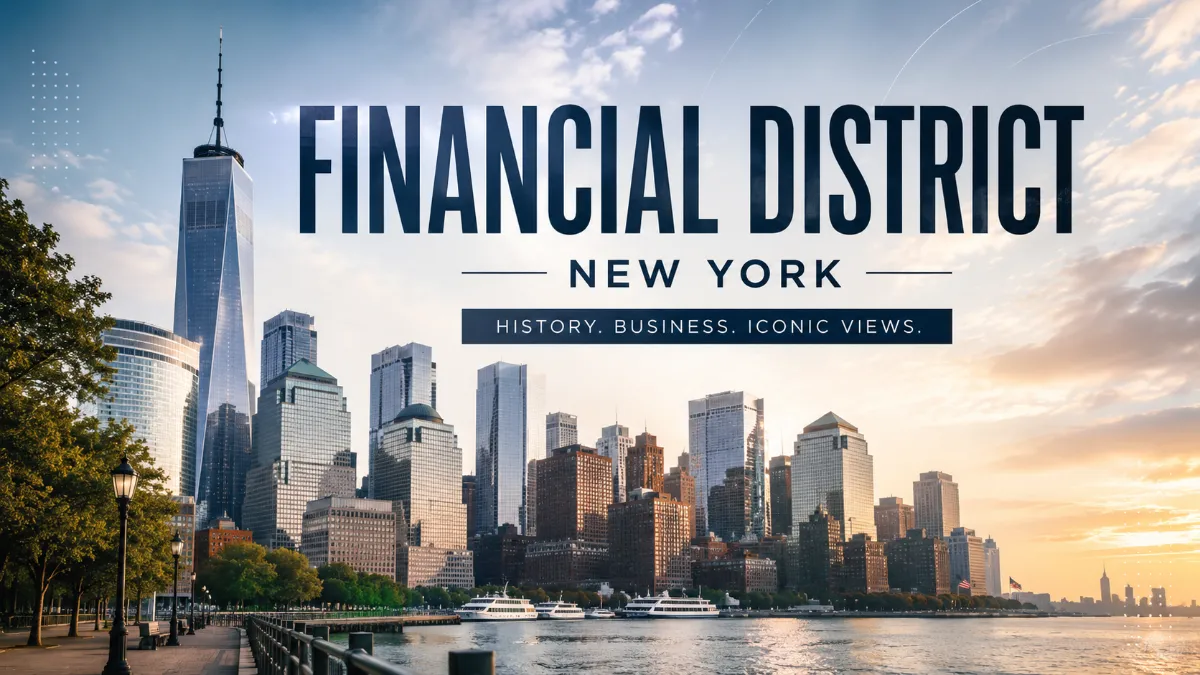
Financial District New York: A Complete Lower Manhattan Travel Guide
The Financial District New York is far more than Wall Street. At Manhattan’s southern tip, this compact neighborhood combines the World Trade Center, the 9/11 Memorial, early American landmarks, waterfront parks, historic streets, major transit connections, and views across New York Harbor.
For first-time visitors, it is one of the most rewarding places in the city to explore on foot. In a well-planned day, you can visit the 9/11 Memorial, see One World Trade Center and the Oculus, stand outside the New York Stock Exchange, walk through Trinity Churchyard, enjoy views toward the Statue of Liberty from The Battery, and end the day near Stone Street or South Street Seaport.
What Is the Financial District in Manhattan?
The Financial District, commonly called FiDi, occupies the southern end of Manhattan and centers on Wall Street, Broad Street, the World Trade Center, and the waterfront near New York Harbor. It is New York City’s historic financial core, but it is equally important as a district of American political history, memorial sites, landmark architecture, museums, and public parks.
The neighborhood is generally associated with the area south of City Hall Park. The Battery, Battery Park City, the Civic Center, Tribeca, and South Street Seaport sit nearby and can easily be included in the same Lower Manhattan itinerary.
Unlike Midtown Manhattan’s regular grid, FiDi has narrow and irregular streets that reflect its colonial-era layout. That adds character, but it can make navigation less intuitive. Keep a map open on your phone or download one before you arrive.
Read more: Financial District New York
Why Visit the Financial District New York?
The Financial District brings together several defining parts of New York City in a relatively small area: the country’s early political history, the symbols of global finance, the legacy of September 11, and the harbor that shaped New York’s rise as a world city.
It suits many kinds of travelers:
- History-focused visitors can explore Federal Hall, Fraunces Tavern, Trinity Church, and St. Paul’s Chapel.
- Architecture lovers can see One World Trade Center, the Oculus, the New York Stock Exchange façade, and historic skyscrapers around Wall Street.
- Families can combine The Battery, the Staten Island Ferry, the National Museum of the American Indian, and South Street Seaport.
- First-time visitors can use the district to connect the 9/11 Memorial, One World Observatory, the Statue of Liberty ferry, Brooklyn Bridge, and Lower Manhattan waterfront.
- Food-focused travelers can plan around Stone Street, Pier 17, Brookfield Place, and the restaurants around the World Trade Center.
The mood changes through the week. Weekday mornings and afternoons are busy with office workers and visitors, while evenings and weekends can feel quieter, especially on streets dominated by office buildings.
A Short History of Lower Manhattan
Lower Manhattan was New York’s center long before it became the center of American finance. The area developed around the Dutch settlement of New Amsterdam in the 17th century, and its streets still preserve the irregular pattern of that early settlement.
Wall Street takes its name from a defensive wall built by Dutch colonists in the 1600s near the route of today’s street. As New York grew into a major port, the area became a center for trade, shipping, insurance, banking, and eventually securities markets.
The district also played a defining role in the early United States. Federal Hall stands on the site where George Washington took the oath of office as the first U.S. president on April 30, 1789. The original building also housed the first Congress, Supreme Court, and early federal offices.
By the 19th and 20th centuries, Wall Street became a global shorthand for American finance. The New York Stock Exchange, major banks, insurers, and investment firms established the area’s international identity.
Today, the Financial District is both a working business center and a residential neighborhood. The rebuilt World Trade Center site added One World Trade Center, the 9/11 Memorial & Museum, the Oculus transportation hub, public spaces, retail, offices, and new connections to Lower Manhattan.
Top Attractions in the Financial District NYC
The best things to do in Financial District NYC range from internationally known landmarks to quieter historical sites. Grouping attractions by location makes the neighborhood easier to explore without unnecessary backtracking.
9/11 Memorial and Museum
The National September 11 Memorial & Museum is one of the most significant places to visit in Lower Manhattan. The outdoor Memorial contains two reflecting pools built in the footprints of the former Twin Towers. The names of those killed in the September 11, 2001 attacks and the February 26, 1993 World Trade Center bombing are inscribed around the pools.
The Memorial is free to visit. The Museum is a separate ticketed experience and requires advance ticket purchase. It presents historical context, personal accounts, artifacts, and exhibitions related to the attacks and their aftermath.
Allow at least 30 to 45 minutes for the outdoor Memorial. Allow two hours or more for the Museum, particularly if you want to take in the exhibits without rushing. Arrive with extra time for security procedures and timed entry.
This is not a casual sightseeing stop. Give the site sufficient time and emotional space.
One World Trade Center and One World Observatory
One World Trade Center is the defining modern landmark of Lower Manhattan. The building reaches 1,776 feet, a height chosen to reference the year of American independence.
One World Observatory occupies floors 100 through 102 and provides broad views over Manhattan, New York Harbor, Brooklyn, New Jersey, and the surrounding boroughs. It is an indoor observatory rather than an open-air deck.
Advance booking is sensible for weekends, school holidays, summer dates, and sunset entry times. Standard admission uses a timed-entry format, and operating hours, ticket options, and prices can change. Check current details shortly before visiting.
The observatory is open daily, with published hours typically running from 9 a.m. to 9 p.m.; seasonal, holiday, and special-event changes are possible. The entrance is at One World Trade Center near West and Vesey Streets.oneworldobservatory+2
Wall Street and the New York Stock Exchange
Wall Street is short, historic, and usually busy with visitors. The key area lies around Wall Street and Broad Street, where you can see the exterior of the New York Stock Exchange.
The NYSE is an active financial institution, not a standard walk-in museum. Do not assume public tours or building access will be available. View the architecture from outside, then continue to nearby Federal Hall, Broad Street, Exchange Place, and Beaver Street.
Nearby points of interest include:
- The New York Stock Exchange façade at 11 Wall Street
- Federal Hall at 26 Wall Street
- The Fearless Girl statue near the NYSE
- The Federal Reserve Bank of New York building on Liberty Street
- The historic streets around Broad Street and Exchange Place
Federal Hall National Memorial
Federal Hall National Memorial stands opposite the New York Stock Exchange at 26 Wall Street. It marks the site where George Washington was inaugurated as the first U.S. president in 1789.
The original Federal Hall was also the first U.S. Capitol under the Constitution, housing the first Congress, Supreme Court, and executive offices. The present building opened in 1842 as the U.S. Custom House and later served as a Sub-Treasury.
It is one of the best stops in the neighborhood for visitors interested in the American Revolution, the founding of the federal government, George Washington, or New York’s period as the first U.S. capital.
Trinity Church and Churchyard
At the western end of Wall Street, Trinity Church offers a striking contrast to the surrounding towers. The current Gothic Revival church dates from the 19th century, while the parish has roots in the colonial era.
The churchyard contains the graves of Alexander Hamilton, Eliza Hamilton, and Angelica Schuyler Church. It is a meaningful stop for anyone interested in early American history, the Revolutionary era, or the people behind the story of Hamilton.
Trinity Church remains an active religious institution. Treat the churchyard as a place of worship and burial: keep noise low, follow posted rules, and check visiting access before arrival if you are traveling during a service or special event.
The Charging Bull
The Charging Bull, located near Bowling Green, is one of the most photographed symbols of Wall Street New York. Created by artist Arturo Di Modica after the 1987 stock-market crash, the bronze sculpture has come to represent market optimism and financial ambition.
Visit early if you want less-crowded photographs. The sculpture is free to see, but the surrounding sidewalks are often busy and the narrow streets make midday photos difficult.
The Battery and Harbor Views
The Battery, often called Battery Park, occupies Manhattan’s southern tip. It offers lawns, waterfront paths, harbor breezes, views toward the Statue of Liberty and Ellis Island, and space to pause after the more crowded World Trade Center and Wall Street areas.
It is also the departure point for the official ferry to the Statue of Liberty and Ellis Island. Official tickets are sold through Statue City Cruises, which operates ferry service from Castle Clinton in The Battery. Buy in advance when possible, particularly during holidays and high-demand travel periods. Ferry schedules change seasonally.nps+2
Do not confuse the official Statue of Liberty ferry with sightseeing boats or third-party ticket sellers nearby. The Staten Island Ferry is free and offers good harbor views, but it does not stop at Liberty Island.
The Oculus and World Trade Center Transportation Hub
The Oculus is the white, wing-like structure at the World Trade Center complex. Designed by Santiago Calatrava, it serves as a transportation hub, retail center, and public architectural landmark.
Even if you are not shopping or traveling to New Jersey by PATH, walk through the central hall. Its bright interior, dramatic ribs, and scale make it one of Lower Manhattan’s most memorable spaces.
The complex connects to several subway lines and PATH service, making it a practical starting point for a day in the neighborhood.
St. Paul’s Chapel
St. Paul’s Chapel, close to Broadway and Fulton Street, is one of Manhattan’s oldest surviving church buildings. It gained international significance after September 11, when it became a place of rest, support, and volunteer activity during the recovery effort.
The chapel offers a quieter perspective than the larger memorial sites and adds important community context to a visit to the World Trade Center area.
South Street Seaport and Pier 17
South Street Seaport sits east of the core Financial District along the East River. Its historic streets, restored sailing vessels, shops, restaurants, and waterfront setting make it an excellent late-afternoon or evening addition to a Lower Manhattan visit.
Pier 17 is particularly appealing for river views. From the waterfront, you can see the Brooklyn Bridge, Manhattan Bridge, and Brooklyn shoreline. It is a good choice for travelers who want scenic dining or a calmer break after Wall Street and the World Trade Center.
Fraunces Tavern
Fraunces Tavern is one of New York City’s leading Revolutionary-era landmarks. It is associated with George Washington’s farewell to his officers at the end of the Revolutionary War and includes a museum as well as dining areas.
The building is a fitting stop for visitors who want a historic attraction combined with a meal or drink in a setting that feels distinct from modern Lower Manhattan.
Best Things to Do in Financial District NYC
Choose attractions based on your interests rather than trying to see everything in one visit.
| If you enjoy | Prioritize | Time to allow |
| September 11 history and remembrance | 9/11 Memorial, 9/11 Museum, St. Paul’s Chapel | 2–4 hours |
| Views and modern architecture | One World Observatory, Oculus, Brookfield Place waterfront | 2–3 hours |
| American history | Federal Hall, Trinity Church, Fraunces Tavern | 2–4 hours |
| Free sightseeing | Wall Street exterior, Charging Bull, Federal Hall, Trinity Church, 9/11 Memorial, The Battery | Half day |
| Waterfront scenery | The Battery, Staten Island Ferry, South Street Seaport, Pier 17 | 2–4 hours |
| A first Lower Manhattan visit | World Trade Center, Wall Street, Trinity Church, The Battery | Full day |
A One-Day Financial District New York Walking Itinerary
This walking itinerary covers the essential sights without making the day feel rushed. Start near the World Trade Center or Fulton Street, then work south and east through the neighborhood.
Morning: World Trade Center and the 9/11 Memorial
Begin at the Oculus and World Trade Center Transportation Hub. Walk through the central hall, then head outside to the 9/11 Memorial.
Spend time at the Memorial before deciding whether to visit the Museum. If you have a timed Museum ticket, organize the morning around that slot. The Museum can be emotionally demanding, so avoid stacking too many activities immediately afterward.
Walk around the exterior of One World Trade Center. If you have tickets for One World Observatory, allow time for entry, the elevator experience, the observation levels, and your return to street level.
Late Morning: St. Paul’s Chapel and Wall Street
Walk east toward St. Paul’s Chapel, then continue south along Broadway or nearby streets toward Trinity Church. From Trinity Church, follow Wall Street to Broad Street.
Stop at the exterior of the New York Stock Exchange and Federal Hall. If Federal Hall is open, take time to explore its interpretive exhibits. Continue south toward Bowling Green.
Early Afternoon: Charging Bull and The Battery
See the Charging Bull near Bowling Green, then walk south into The Battery. This is a natural place for lunch, waterfront views, or a short rest before continuing.
If you have extra time and want a free harbor experience, take the Staten Island Ferry round trip. It is a public transit service used by commuters as well as visitors, so keep walkways and doors clear and follow crew instructions.
Travelers who want to visit Liberty Island should reserve the official Statue City Cruises ferry in advance. The ferry departs from Castle Clinton in The Battery and also serves Ellis Island.nps+2
Afternoon: Choose History or the Seaport
For the final part of the day, choose the route that best fits your interests.
For history: Return north to Fraunces Tavern, then explore Pearl Street, Stone Street, Hanover Square, and the smaller lanes around the historic core.
For waterfront views: Walk east toward South Street Seaport and Pier 17. This route offers views of the Brooklyn Bridge and East River and works well for a late lunch, drink, or dinner.
Getting Around the Financial District
The Financial District is easy to reach by subway, PATH train, bus, ferry, taxi, rideshare, and walking from nearby Lower Manhattan neighborhoods. Because several stations serve the area, choose the station closest to your first stop rather than treating one station as the gateway to the entire district.
Best Subway Stations for FiDi
| Destination | Useful stations |
| World Trade Center and Oculus | WTC Cortlandt, Cortlandt Street, Fulton Street, Chambers Street, PATH World Trade Center |
| Wall Street and the NYSE | Wall Street, Broad Street, Bowling Green |
| 9/11 Memorial and One World Trade Center | WTC Cortlandt, Fulton Street, Chambers Street, Cortlandt Street |
| The Battery and Staten Island Ferry | South Ferry, Whitehall Street, Bowling Green |
| South Street Seaport | Fulton Street, Wall Street, Broad Street |
Service patterns can change because of construction, weekend work, late-night maintenance, and unplanned disruptions. Check the official MTA service status and a current map shortly before setting out.
PATH and Ferries
PATH trains connect the World Trade Center with New Jersey, including Jersey City, Hoboken, and Newark-area connections. The World Trade Center station is integrated with the Oculus complex.
The Staten Island Ferry departs from Whitehall Terminal near The Battery. It is a public transit service rather than a guided tour, but it provides wide harbor views and passes within sight of the Statue of Liberty.
NYC Ferry services at Pier 11/Wall Street connect Lower Manhattan with waterfront neighborhoods in Brooklyn, Queens, and other parts of the city. Routes, schedules, and seasonal operations can change, so confirm details before travel.
Dining in the Financial District
The Financial District has become a much stronger dining neighborhood than its old office-district reputation suggests. It is not New York’s most concentrated area for destination dining, but it offers reliable choices for quick meals, historic settings, waterfront views, food halls, and relaxed evenings.
| Need | Areas to explore | What to expect |
| Breakfast or coffee | Fulton Street, Broadway, World Trade Center area | Cafés, bakeries, grab-and-go counters |
| Fast lunch | Wall Street, Broad Street, Fulton Street | Busy weekday service and casual options |
| Historic atmosphere | Stone Street, Fraunces Tavern area | Cobblestones, pubs, sit-down dining |
| Waterfront dining | Pier 17, Brookfield Place, Battery Park City edge | Scenic settings and often higher prices |
| Flexible group meals | Oculus, Brookfield Place, Seaport area | Food halls and several cuisine options |
| Dinner after sightseeing | Stone Street, Seaport, Battery Park City | More atmosphere after the office rush |
Stone Street is one of the best-known dining areas because its cobblestones and low-rise historic buildings contrast sharply with nearby skyscrapers. It can be particularly lively in warm weather.
For polished waterfront dining or food-hall options, head west toward Brookfield Place and the Battery Park City waterfront. This also gives you access to the Hudson River promenade and views across the river.
Check opening hours before choosing a restaurant. Some venues cater primarily to weekday office workers and may have reduced weekend or evening service.
Is the Financial District Safe for Visitors?
The Financial District is widely visited and generally feels orderly around major attractions, transit hubs, office buildings, and waterfront areas. As in any large city neighborhood, personal safety depends on the time of day, your exact location, awareness, and circumstances.
Use ordinary big-city precautions:
- Stay aware of your surroundings in crowded stations and tourist areas.
- Keep phones, wallets, cameras, and bags secure.
- Use populated, well-lit routes when walking late at night.
- Watch for traffic, cyclists, delivery vehicles, and turning cars at intersections.
- Avoid aggressive ticket sellers and anyone pressuring you to buy tours or ferry tickets.
- Use official ticket platforms or established attraction counters.
- If you need assistance, enter a staffed hotel, museum, store, transit facility, or public attraction.
The neighborhood is often quieter after office hours than Midtown. That can be pleasant, but some streets may feel less active late at night, especially east of Broadway and near office buildings. If you are traveling alone, plan your route back to the subway or hotel before setting out for the evening.
Practical Visitor Tips
A few practical choices make a Financial District visit smoother and more enjoyable.
Book Timed Attractions First
The 9/11 Museum and One World Observatory are the attractions most likely to determine your schedule. Reserve timed entry first, then plan nearby landmarks around those commitments.
The outdoor 9/11 Memorial is free to visit. The Museum requires a separate advance ticket purchase. Verify current hours and entry policies before your visit because they can change.
Wear Comfortable Shoes
The neighborhood is compact, but walking can add up quickly. Uneven cobblestones, crowds, broad plazas, and detours around major attractions make comfortable walking shoes essential.
Arrive Early for Photos
For better photographs and fewer people, visit the Charging Bull, Wall Street, the Oculus, and the 9/11 Memorial early in the day. The first hour after opening is often calmer than midday.
Allow Time for Security
Museums, observatories, ferries, and some historic buildings may have bag checks or security screening. Carry only what you need and avoid scheduling tight connections immediately after timed attractions.
Do Not Expect NYSE Entry
The New York Stock Exchange is a working institution with restricted access. Plan to view its exterior rather than building an itinerary around an assumed interior visit or public tour.
Use a Map for Street Names
FiDi streets do not follow Manhattan’s numbered grid. A map app will help you avoid accidental loops and identify the quickest route between Wall Street, the World Trade Center, The Battery, and South Street Seaport.
Combine Nearby Lower Manhattan Attractions
The district works best as part of a wider Lower Manhattan day. Natural additions include:
- Brooklyn Bridge and City Hall Park to the north
- Battery Park City and Brookfield Place to the west
- South Street Seaport and Pier 17 to the east
- Chinatown, Little Italy, and SoHo farther north
Financial District New York: The Best Way to Experience It
The best way to experience the Financial District New York is to balance famous landmarks with time to understand the neighborhood’s layers. Visit the 9/11 Memorial thoughtfully, look beyond Wall Street to Federal Hall and Trinity Church, and make room for the harbor at The Battery or the East River waterfront.
If you have one day, prioritize the World Trade Center, 9/11 Memorial, Oculus, Wall Street, Federal Hall, Trinity Church, Charging Bull, and The Battery. With more time, add the 9/11 Museum, One World Observatory, Fraunces Tavern, South Street Seaport, and a ferry experience.
A visit here is not simply a trip to a financial center. It is a walk through the place where New York’s colonial past, the founding of the United States, global commerce, public memory, and the modern skyline meet.
Frequently Asked Questions
Is the Financial District worth visiting in New York City?
Yes. The Financial District is worthwhile even if finance is not your main interest. It includes the 9/11 Memorial, One World Trade Center, the Oculus, Wall Street, Federal Hall, Trinity Church, The Battery, and easy access to harbor views. It is especially useful for first-time visitors who want major Lower Manhattan landmarks within a walkable area. A half day covers the primary outdoor sights, while a full day gives you time for the 9/11 Museum, One World Observatory, a ferry, and South Street Seaport.
How much time do you need in the Financial District NYC?
Allow three to four hours for Wall Street, Federal Hall, Trinity Church, the Charging Bull, the Oculus, and the outdoor 9/11 Memorial. Plan a full day if you also want the 9/11 Museum, One World Observatory, The Battery, the Staten Island Ferry, Fraunces Tavern, or South Street Seaport. The distances are manageable, but security lines, timed entry, crowds, and time spent at memorial sites can extend your visit.
Can tourists go inside the New York Stock Exchange?
Tourists should not expect routine public entry or tours of the New York Stock Exchange. The NYSE is an active institution with security measures and access policies that can change. Most visitors photograph the exterior on Broad Street, then visit nearby Wall Street, Federal Hall, the Fearless Girl statue, and the Charging Bull. If access is important to your trip, verify current NYSE visitor information before traveling rather than relying on older guides.
What is the best subway stop for Wall Street New York?
The right subway stop depends on your first attraction. Wall Street stations are convenient for Federal Hall and the New York Stock Exchange area, Broad Street is close to the NYSE, and Bowling Green is useful for the Charging Bull and The Battery. For the World Trade Center, 9/11 Memorial, and Oculus, use WTC Cortlandt, Fulton Street, Cortlandt Street, or Chambers Street. Check current MTA service before leaving, particularly during weekends or overnight maintenance.
Is the 9/11 Memorial free to visit?
Yes. The outdoor 9/11 Memorial is free and open to the public daily. It includes two reflecting pools in the footprints of the former Twin Towers, surrounded by the names of people killed in the 1993 and 2001 attacks. The adjacent 9/11 Memorial Museum is a separate ticketed attraction and requires advance ticket purchase. Check current opening times, timed-entry rules, and any special schedules before your visit.
Is One World Observatory worth it?
One World Observatory is a strong choice if panoramic views are a priority and you want to see New York from Lower Manhattan. It has indoor viewing areas across floors 100 through 102 of One World Trade Center, with views over the harbor, Brooklyn, Midtown, and New Jersey. It is best booked in advance for high-demand periods. Travelers on a limited budget can still enjoy free waterfront views from The Battery, the Staten Island Ferry, Brooklyn Bridge, and Battery Park City.
Where can you see the Statue of Liberty from the Financial District?
The Battery offers one of the best free views of the Statue of Liberty from Manhattan. Walk along the waterfront at the southern end of the park for clear harbor sightlines. The Staten Island Ferry also provides good views during its crossing, though it does not stop at Liberty Island. To visit the Statue of Liberty itself, use the official Statue City Cruises ferry from Castle Clinton in The Battery. Advance booking is advisable during busy periods.
What are the best free things to do in the Financial District?
Free Financial District attractions include the 9/11 Memorial, the Oculus, Wall Street, the exterior of the New York Stock Exchange, the Charging Bull, Federal Hall when open, Trinity Church and its churchyard when accessible, The Battery, and the South Street Seaport waterfront. You can also take the Staten Island Ferry for a free harbor crossing with views of the Statue of Liberty. Together, these stops make Lower Manhattan an excellent choice for budget-conscious sightseeing.
Is the Financial District a good place to stay in NYC?
The Financial District can be an excellent place to stay if you prefer a calmer base than Midtown, want easy access to Lower Manhattan attractions, or need strong transport connections to Brooklyn, New Jersey, and other parts of Manhattan. It may be less convenient for travelers who plan frequent late nights in Midtown or repeated trips to Central Park. Choose accommodation near a subway station and confirm nearby dining options, since activity and opening hours can vary by block and day.
What should you combine with a Financial District itinerary?
The easiest additions are the Brooklyn Bridge, City Hall Park, South Street Seaport, Battery Park City, and the Staten Island Ferry. History-oriented visitors can add Fraunces Tavern, the National Museum of the American Indian, and Chinatown. For a scenic route, walk north from The Battery along the Hudson River waterfront or head east to Pier 17 for Brooklyn Bridge views. A popular full-day extension is to walk the Brooklyn Bridge and continue into DUMBO for skyline photography and waterfront parks.


You May Also Like

PetSmart Grooming: Prices, Services, Appointments, Requirements
Pink Floyd: History, Members, Albums, Songs, and Legacy