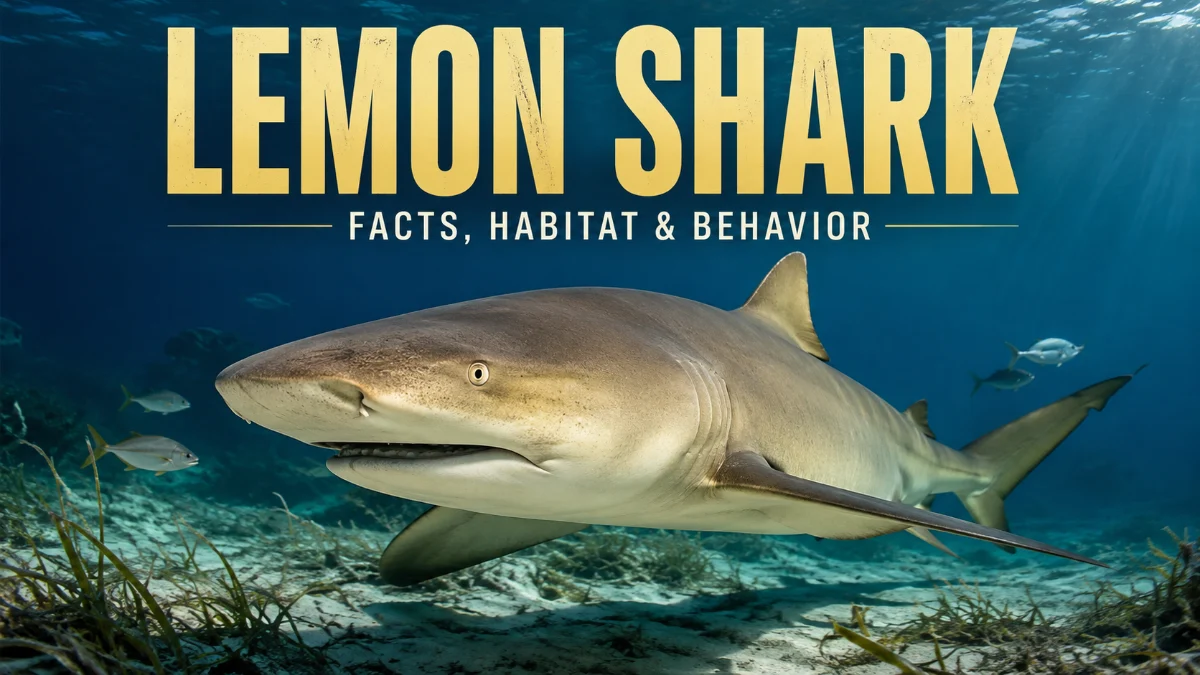
The lemon shark (Negaprion brevirostris) is a large, yellow-brown coastal shark found in warm, shallow waters around mangroves, estuaries, lagoons, reefs, and sandy bottoms. Its broad head, short snout, and two similarly sized dorsal fins make it easier to recognize than many other sharks. This species is an important predator in connected coastal ecosystems, but its slow life history and reliance on nursery habitat make it vulnerable to fishing pressure and habitat loss.
Quick Facts About the Lemon Shark
| Feature | Details |
| Scientific name | Negaprion brevirostris |
| Family | Carcharhinidae (requiem sharks) |
| Typical adult length | About 2.4–3 m (7.9–9.8 ft) |
| Maximum recorded length | About 3.4 m (11.2 ft) |
| Size at birth | About 60–65 cm (24–26 in) |
| Estimated maximum lifespan | Up to about 37 years |
| Main habitat | Mangroves, estuaries, lagoons, bays, reefs, seagrass flats, and sandy or muddy bottoms |
| Diet | Mainly fish, crustaceans, rays, smaller sharks, and mollusks |
| Reproduction | Live-bearing, with a yolk-sac placenta |
| Gestation | About 10–12 months |
| Litter size | Usually 4–17 pups |
| Conservation status | Vulnerable globally |
| Risk to people | Generally low, but it is a large wild predator and can bite if disturbed or handled |
What Is a Lemon Shark?
A lemon shark is a cartilaginous fish in the requiem shark family, Carcharhinidae. Its name comes from its pale yellow-brown to olive coloration, which helps it blend into the sandy or muddy bottoms of the inshore habitats where it often feeds.
Like other sharks, it has a skeleton made mostly of cartilage, five gill slits on each side of the head, replaceable teeth, and skin covered in tiny tooth-like scales called dermal denticles. It is built for steady movement through coastal water rather than the extreme bursts of speed associated with some open-ocean sharks.
Read more: Lemon Shark
Taxonomy
| Taxonomic rank | Classification |
| Kingdom | Animalia |
| Phylum | Chordata |
| Class | Chondrichthyes |
| Subclass | Elasmobranchii |
| Order | Carcharhiniformes |
| Family | Carcharhinidae |
| Genus | Negaprion |
| Species | Negaprion brevirostris |
The genus Negaprion includes two living species: the lemon shark and the sicklefin lemon shark (Negaprion acutidens). The lemon shark occurs mainly in the Atlantic and eastern Pacific, while the sicklefin lemon shark is primarily an Indo-Pacific species.
How to Identify a Lemon Shark
A lemon shark is best identified by a combination of coloration, body shape, fin proportions, and location. Its yellow-brown, tan, or olive upper body can be a useful clue, but lighting and water conditions can make several shark species look similar.
The most practical field mark is its two dorsal fins, which are relatively similar in size. Many other coastal sharks have a much larger first dorsal fin and a noticeably smaller second dorsal fin.
Lemon Shark Identification Features
| Feature | What to look for |
| Body color | Yellowish, tan, olive-gray, or yellow-brown upper body |
| Underside | Pale yellow to off-white |
| Head | Broad and flattened, with a short, rounded snout |
| Dorsal fins | Two dorsal fins of similar size |
| Pectoral fins | Broad and relatively large |
| Body shape | Stout, streamlined body |
| Teeth | Narrow, pointed teeth suited to gripping prey |
| Typical setting | Shallow bays, mangroves, estuaries, reefs, lagoons, and sandy bottoms |
Color alone is not enough for dependable identification. Consider the shark’s dorsal-fin proportions, body profile, habitat, behavior, and geographic location.
Lemon Shark Habitat and Range
Lemon sharks are mainly found in warm, shallow coastal environments. They use mangroves, estuaries, lagoons, bays, river mouths, seagrass flats, coral reefs, and sandy or muddy seafloors. Although they can enter brackish water, they are primarily marine sharks and are not freshwater specialists.
Young sharks rely heavily on protected nursery areas. Mangrove-fringed lagoons, shallow beaches, tidal creeks, and estuaries provide food, structured cover, and reduced exposure to some larger predators. Juveniles may remain in these habitats for years before their home range expands into deeper and broader coastal waters.
Geographic Range
The species occurs in tropical, subtropical, and warm-temperate waters of the western Atlantic, from the southeastern United States south through the Gulf of Mexico, Caribbean, Central America, and Brazil. It is also reported from coastal West Africa and the eastern Pacific, from Mexico to Ecuador.
Its range is not continuous across every coastline within these regions. Local occurrence depends on temperature, prey, depth, habitat quality, life stage, season, and access to sheltered coastal areas.
Why Mangrove Nursery Habitat Matters
Mangroves are especially important for juvenile sharks because their submerged roots create structured, shallow habitat that supports fish and crustaceans. The roots can also make it harder for larger predators to move through the area.
When mangroves are cleared, filled, polluted, or altered by coastal development, young sharks can lose essential places to feed and grow. These habitats also support seagrass meadows, reef-associated fish, crustaceans, and other wildlife, making their protection important across the whole coastal food web.
Lemon Shark Diet
Lemon sharks are opportunistic carnivores. Their diet changes with body size, habitat, season, and local prey availability. Juveniles typically consume smaller prey, while adults can take larger fish, rays, and other marine animals.
Common Prey
| Prey group | Examples |
| Bony fish | Mullet, jacks, catfish, croakers, porcupinefish, and cowfish |
| Rays | Stingrays, eagle rays, and guitarfish |
| Crustaceans | Crabs and other coastal crustaceans |
| Other sharks | Smaller shark species |
| Mollusks | Squid, octopus, and other cephalopods |
Fish and crustaceans are important parts of the diet, but prey differs between mangrove lagoons, seagrass beds, reefs, estuaries, and open sandy flats.
How Lemon Sharks Find Prey
Lemon sharks use several senses while hunting:
- Smell detects dissolved chemical cues in the water.
- Hearing detects low-frequency sounds and vibrations.
- Vision helps them orient and detect prey in suitable light.
- The lateral line detects water movement and pressure changes.
- Electroreception allows them to detect weak electrical fields produced by nearby animals.
These senses work together in murky estuaries, around mangrove roots, and over sandy bottoms where prey may be hidden.
Lemon Shark Behavior
Lemon sharks are active coastal predators that often cruise near the seafloor, across sand flats, through lagoons, and along reef edges. They may be encountered alone or near other sharks, especially in productive nursery habitat.
Juveniles can show site fidelity, meaning they repeatedly use familiar habitats or return to the same area. Their movements are not random: water temperature, tides, food availability, predator risk, and habitat structure can influence where they spend time.
Social Behavior and Movement
Young lemon sharks can form repeated associations with similarly sized individuals. These associations are not permanent family groups, but they show that sharks may respond to social and environmental conditions rather than moving entirely independently.
Acoustic telemetry has helped researchers document how young sharks use nursery grounds and make seasonal movements. Some juveniles remain strongly associated with a region in winter, then move hundreds of kilometres during seasonal shifts before returning in later years.
Do Lemon Sharks Hunt at Night?
They can be active in low-light conditions and may feed at different times depending on local prey behavior. However, lemon sharks are not strictly nocturnal. Their activity patterns vary with location, life stage, water temperature, tides, visibility, and prey availability.
Reproduction and Life Cycle
Lemon sharks reproduce through internal fertilization and give birth to live young. They are placental viviparous: embryos initially use yolk and later receive nourishment through a yolk-sac placenta.
Mating occurs in shallow water, often during spring and summer in studied populations. Females give birth after a gestation period of about 10–12 months. Litters usually contain 4–17 pups, and newborn sharks measure around 60–65 cm (24–26 in).
Life Cycle at a Glance
| Life stage | Typical characteristics |
| Embryo | Develops inside the mother during a 10–12 month gestation |
| Newborn pup | Born alive at about 60–65 cm (24–26 in) |
| Juvenile | Uses mangroves, lagoons, tidal creeks, estuaries, and shallow beaches |
| Subadult | Expands into broader coastal habitats and deeper water |
| Adult | Reaches sexual maturity after more than a decade and returns to shallow coastal areas to reproduce |
Females in some studied populations reproduce on a biennial cycle, which leaves little margin for rapid population recovery when adults are removed faster than they can be replaced.
What Eats Lemon Sharks?
Adult lemon sharks have relatively few natural predators because of their size. Young sharks are more vulnerable and may be eaten by larger sharks, including larger lemon sharks.
Protected nursery habitat reduces some predation risk but does not eliminate it. The shallow-water shelter, abundant prey, and complex structure of mangroves and lagoons are particularly important during the earliest life stages.
Humans are also a major source of mortality through targeted fishing, incidental catch in fishing gear, habitat loss, and the degradation of coastal nursery grounds.
Ecological Role in Coastal Food Webs
Lemon sharks occupy a high trophic level in coastal ecosystems. They feed on fish, rays, crustaceans, and smaller sharks, while juveniles may themselves be preyed upon by larger sharks.
Their role should not be oversimplified. A single predator does not control an entire ecosystem, and coastal food webs are also shaped by habitat condition, fishing, prey abundance, climate, pollution, and competition. Still, large predators can influence where prey animals feed, how they move, and how energy passes through marine habitats.
Why Their Role Matters
Healthy populations depend on connected habitats:
- Mangroves and shallow lagoons provide nursery grounds.
- Seagrass flats and estuaries support juvenile prey.
- Reefs and coastal shelves provide feeding and movement corridors.
- Adult sharks connect different habitats through movement and predation.
Protecting this species therefore supports a broader network of coastal ecosystems rather than only one shark population.
Lemon Shark vs. Bull Shark
Lemon sharks and bull sharks can both occur in warm coastal water, but they differ in body shape, dorsal-fin proportions, coloration, and freshwater tolerance.
| Feature | Lemon shark | Bull shark |
| Scientific name | Negaprion brevirostris | Carcharhinus leucas |
| Typical color | Yellow-brown, olive, or tan | Gray upper body with a pale underside |
| Body build | Stout but streamlined | Very stocky and broad-bodied |
| Snout | Broad and relatively short | Broad, blunt, and rounded |
| Dorsal fins | Similar in size | First dorsal fin much larger than the second |
| Typical habitat | Coastal marine shallows, mangroves, bays, lagoons, and reefs | Coastal waters, estuaries, and freshwater rivers |
| Freshwater use | Can tolerate brackish water | Can travel far into freshwater |
| Human interaction | Rarely involved in unprovoked bites | More often involved in reported unprovoked bites than this species |
Lemon Shark vs. Nurse Shark
Nurse sharks and lemon sharks may both be seen in shallow tropical water, but their body form and behavior are noticeably different.
| Feature | Lemon shark | Nurse shark |
| Scientific name | Negaprion brevirostris | Ginglymostoma cirratum |
| Family | Carcharhinidae | Ginglymostomatidae |
| Body shape | Streamlined, active-swimming shark | Broad, flatter-bodied bottom-dwelling shark |
| Color | Yellow-brown or olive | Tan to gray-brown |
| Barbels | None visible | Distinct sensory barbels near the nostrils |
| Mouth position | More forward on the underside of the head | Positioned well underneath the head |
| Typical activity | Cruises through coastal habitat | Often rests on the bottom |
| Feeding style | Pursues fish, rays, and crustaceans | Uses suction to take bottom-dwelling prey |
Lemon Shark vs. Sandbar Shark
Sandbar sharks and lemon sharks can both occur in coastal bays and nearshore waters. Their dorsal fins are one of the clearest differences.
| Feature | Lemon shark | Sandbar shark |
| Scientific name | Negaprion brevirostris | Carcharhinus plumbeus |
| Main color | Yellow-brown or olive | Gray to gray-brown |
| First dorsal fin | Large, with a second dorsal fin of similar size | Very tall and triangular |
| Second dorsal fin | Relatively large | Much smaller than the first |
| Snout | Broad and short | Rounded and moderately long |
| Common habitat | Mangroves, lagoons, shallow bays, and sandy coastal water | Coastal shelves, bays, estuaries, and deeper nearshore water |
| Overall impression | Yellowish shark with two similar dorsal fins | Gray shark with a conspicuously tall first dorsal fin |
A photograph or brief underwater encounter may not provide enough information for certainty. Never touch, restrain, or approach a shark closely to identify it.
Are Lemon Sharks Dangerous to Humans?
Lemon sharks are large, powerful wild animals and can bite if provoked, handled, hooked, trapped, or attracted by bait. They are not generally regarded as a leading threat to swimmers, but a low-risk species is not a risk-free species.
Responsible Wildlife Viewing
- Keep a respectful distance and let the shark choose its route.
- Do not touch, chase, block, feed, or crowd sharks.
- Avoid entering the water near active fishing, bait, or spearfishing.
- Follow local rules, marine-park guidance, and qualified dive professionals.
- Choose wildlife operators that prioritize animal welfare and do not manipulate sharks for photos.
Lemon Shark Conservation Status
The lemon shark is globally listed as Vulnerable, meaning available evidence indicates that it faces a high risk of extinction in the wild. Local populations can experience very different pressures, so global status does not describe every region equally.
Older material may show a different category because conservation assessments change as new information becomes available.
Major Threats
| Threat | Why it matters |
| Targeted fishing | Sharks may be harvested for meat, fins, and other products |
| Bycatch | Individuals can be caught unintentionally in longlines, nets, and other fishing gear |
| Recreational fishing | Survival after release depends on handling, hook injury, exhaustion, and local conditions |
| Mangrove loss | Removes essential nursery habitat |
| Coastal development | Dredging, construction, and altered water flow can degrade shallow-water habitat |
| Pollution | Water-quality decline can affect sharks, prey, and nursery ecosystems |
| Slow reproduction | Late maturity and relatively small litters limit recovery after population declines |
Research and Scientific Discoveries
Lemon sharks are among the most studied coastal shark species because juveniles use identifiable nursery habitats that can be monitored over time. Research in the Bahamas, Florida, and the U.S. South Atlantic has improved understanding of their movement, growth, habitat use, survival, social associations, reproduction, and responses to environmental change.
Bimini Nursery Research
Bimini in The Bahamas is a well-known location for research on juvenile sharks. Studies in and around its shallow mangrove-connected habitats have used tagging, genetics, and acoustic telemetry to investigate how young animals move through nurseries and later return to particular areas.
Long-term tracking has shown that tagged individuals can survive for many years and continue to use predictable habitats as they mature. Such work helps identify breeding sites, nursery grounds, movement corridors, and places where habitat protection can be especially valuable.
What Acoustic Telemetry Reveals
Acoustic telemetry uses a small tag carried by the shark and submerged receivers that record when the tagged animal passes nearby. This approach enables scientists to study movement and habitat use without continuously following an animal by boat or diver.
Studies have revealed a pattern of strong nursery-area use alongside seasonal travel. This helps researchers understand how water temperature, habitat structure, and coastal development may influence survival and movement.
Did You Know? Lemon Shark Facts
- The yellow-brown body color helps it blend into sandy and muddy shallow-water habitats.
- Its two dorsal fins are similar in size, a useful identification feature.
- Adults commonly measure about 2.4–3 m (7.9–9.8 ft).
- The species can reach about 3.4 m (11.2 ft).
- Pups are born alive rather than hatching from egg cases.
- Newborns measure about 60–65 cm (24–26 in).
- Juveniles may remain in mangrove and lagoon nurseries for years.
- Young sharks can form repeated associations with similarly sized individuals.
- Acoustic tracking can reveal movements between nursery grounds and broader coastal habitats.
- The species is globally listed as Vulnerable.
Frequently Asked Questions
Why are lemon sharks yellow?
They are not bright yellow, but their bodies often have a yellow-brown, tan, or olive tint. This coloration helps them blend into sandy and muddy seafloors in shallow water. The shade may appear stronger or weaker depending on sunlight, depth, water clarity, and the individual animal. Color is only one identification clue; the broad head and two similarly sized dorsal fins are more useful features for distinguishing this shark from several other coastal species.
Can lemon sharks bite?
Yes. Like all large sharks, they have sharp teeth and can bite if they are threatened, handled, hooked, trapped, or attracted by food. They should never be treated as harmless or approached for close contact. Most responsible encounters are passive: people remain calm, avoid bait and fishing activity, maintain distance, and allow the shark to move away freely. Respectful observation is safer for both people and animals.
How fast can lemon sharks swim?
There is no single, well-established top-speed measurement for this species. Swimming speed changes with body size, water conditions, and whether the shark is cruising, hunting, escaping, or migrating. Tracking research has documented substantial seasonal travel by juveniles, but distance traveled in a day is not the same as an instantaneous swimming speed. They are capable of efficient, sustained movement through coastal water, but precise speed claims should be treated cautiously.
What predators eat lemon sharks?
Young lemon sharks are vulnerable to larger sharks, including potentially larger individuals of their own species. Their shallow nursery habitats offer some protection, but they do not remove predation risk. Adults have fewer natural predators because of their size, although larger sharks may still pose a threat. Human activities are also a major source of mortality through fishing, bycatch, habitat loss, and damage to mangrove and estuarine nursery systems.
Can lemon sharks live in aquariums?
Lemon sharks are not suitable for home aquariums. They grow into large, active coastal predators that need an enormous amount of swimming space, stable marine conditions, specialized care, and experienced veterinary oversight. Public aquariums that keep large sharks require purpose-built systems, trained staff, and legal authorizations. Keeping them privately creates serious welfare concerns and should not be attempted.
Do lemon sharks sleep?
They do not sleep in the same way humans do. Sharks have periods of lower activity and rest, but their gills still need water flowing across them. Some sharks can pump water over their gills while resting, while others need to keep moving more consistently. Lemon sharks are often seen swimming slowly rather than lying motionless for extended periods. The details of shark rest behavior remain an active research topic.
Are lemon sharks endangered everywhere?
No. The global classification is Vulnerable, but local conditions differ widely. Some populations may benefit from protected habitat, fishing limits, or stronger enforcement, while others face more severe fishing pressure and coastal development. A global conservation category is an assessment of overall extinction risk, not a guarantee that every population is declining at the same rate. Local management and habitat quality strongly affect conservation outcomes.
Why are juvenile lemon sharks studied so often?
Young sharks use recognizable shallow nursery areas, including mangrove lagoons, tidal creeks, and protected coastal bays. This makes it practical to study their movement, survival, growth, habitat use, and behavior through tagging and acoustic telemetry. Their predictable use of these habitats also helps scientists assess how coastal development, water quality, warming temperatures, and changes in mangrove cover may affect shark populations.
Can lemon sharks survive in freshwater?
They can tolerate brackish water and may enter estuaries or river mouths, but they are primarily marine coastal sharks. They are not known for the prolonged freshwater use associated with bull sharks. Their most important habitats include saltwater and brackish systems such as mangrove-fringed lagoons, bays, estuaries, seagrass flats, and shallow reef areas.
Where can lemon sharks be seen responsibly?
They can be encountered in some warm-water coastal regions within their range, especially in clear shallow habitats near reefs, lagoons, and mangrove-connected waters. Sightings depend on season, regulations, water conditions, and the sharks’ own movements. Choose licensed, welfare-focused wildlife operators that follow local rules, avoid baiting or crowding, and allow sharks to control the distance and direction of every encounter.
