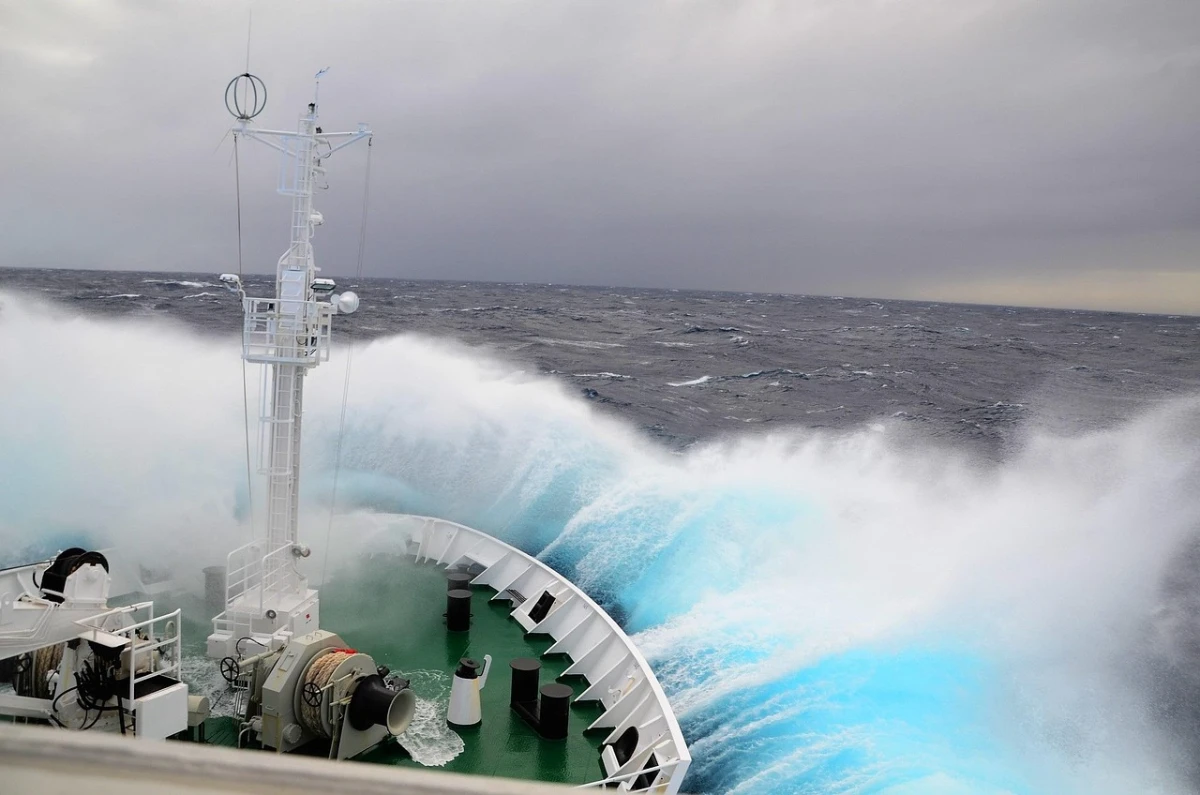
The Drake Passage is the stretch of Southern Ocean between Cape Horn at the southern tip of South America and the South Shetland Islands near Antarctica. It is the shortest sea route from South America to the Antarctic Peninsula and is renowned for powerful winds, long swells, and the Antarctic Circumpolar Current. Most expedition ships take about 36–48 hours to complete a one-way crossing.
For travelers, it is the unpredictable gateway to Antarctica. For scientists, it is a key observation point for understanding ocean circulation, climate, marine ecosystems, and the movement of heat and carbon through the Southern Ocean.
Drake Passage at a Glance
| Fact | Details |
| Location | Between Cape Horn, Chile, and the South Shetland Islands near Antarctica |
| Connected waters | Southeastern Pacific, Scotia Sea in the southwestern Atlantic sector, and the Southern Ocean |
| Narrowest width | About 800 km (500 miles), between Cape Horn and Livingston Island |
| Common broader width | About 1,000 km (600 miles), depending on the measurement points used |
| Average depth | About 3,400 m (11,000 ft) |
| Deepest areas | More than 4,800 m (15,600 ft) in some parts |
| Typical ship crossing | Around 36–48 hours one way |
| Major current | Antarctic Circumpolar Current |
| Current transport | Commonly estimated in the broad range of 100–150 Sverdrups |
| Traditional cruise gateway | Ushuaia, Argentina |
| Common fly-cruise gateway | Punta Arenas, Chile, via King George Island |
| Main visitor season | Generally November to March |
One Sverdrup equals 1 million cubic metres of water per second. Exact width, depth, and transport estimates vary by the boundaries and measurement methods used, but the central fact is clear: this is the narrowest major gateway through which the Antarctic Circumpolar Current flows around the continent.
Where Is the Drake Passage?
The passage separates South America from Antarctica. Cape Horn and Tierra del Fuego lie to its north, while the South Shetland Islands lie to its south. The Antarctic Peninsula begins farther south beyond those islands.
A traditional Antarctica cruise usually departs from Ushuaia, Argentina, and heads south across open ocean toward the South Shetland Islands and Antarctic Peninsula. The ship’s route is not fixed: captains adjust it for wind, swell, weather systems, sea ice, visibility, and operational requirements.
Read more: Drake Passage
Drake Passage map: how to visualize the route
text
South America
|
Ushuaia, Argentina
|
Cape Horn / Tierra del Fuego
|
| Drake Passage
| Southern Westerlies + Antarctic Circumpolar Current
|
South Shetland Islands
|
King George Island
|
Antarctic Peninsula
The passage links the southeastern Pacific with the Scotia Sea, part of the southwestern Atlantic sector. It lies within the Southern Ocean, the only ocean that extends around the globe without being interrupted by a continental landmass.
A fly-cruise usually begins in Punta Arenas, Chile. Passengers fly to King George Island in the South Shetlands, then board an expedition vessel for the Antarctic Peninsula. Depending on the itinerary, this can avoid the open-ocean crossing altogether or reduce it to one sea passage.
Why the Drake Passage Is So Rough
The Drake Passage can be rough because it lies below a broad, largely uninterrupted belt of strong westerly winds. Those winds can blow across immense distances of open water, creating long swells that travel through the Southern Ocean.
It is also a constriction in the path of the Antarctic Circumpolar Current (ACC), the world’s largest ocean-current system. The ACC moves predominantly eastward around Antarctica and carries an enormous volume of water through the passage. Strong current, large swell, wind, and changing low-pressure systems can combine to create difficult conditions.
How waves form during a Drake Passage crossing
Several factors may combine to produce uncomfortable or severe seas:
- Persistent Southern Westerlies and passing low-pressure systems.
- Long, uninterrupted wind fetch across the Southern Ocean.
- Large swells generated by distant storms.
- Cross-seas, where waves arrive from more than one direction.
- Rapidly shifting fronts and wind changes.
- The vessel’s speed and heading relative to the waves.
A calm start does not guarantee a calm voyage, and a rough departure does not mean every hour will be uncomfortable. Forecasts help crews plan, but weather in the Southern Ocean can evolve quickly.
Drake Lake vs. Drake Shake
“Drake Lake” and “Drake Shake” are informal passenger and crew terms, not official weather classifications. They describe the very different conditions possible on the same crossing.
| Term | General conditions | Passenger experience |
| Drake Lake | Relatively calm water and low swell | Easier movement around the vessel and a lower risk of motion sickness |
| Moderate crossing | Noticeable rolling and pitching | Most passengers can participate normally with sensible preparation |
| Drake Shake | Stronger swell, wind, and sustained vessel movement | Motion sickness becomes more common; outside decks may close |
| Severe weather | High seas and strong winds | The bridge team may reduce speed, adjust heading, change route, or restrict activities |
No cruise operator can guarantee Drake Lake conditions. No month can guarantee them either. These terms are useful for setting expectations, not predicting what an individual voyage will feel like.
Drake Passage Weather by Month
Antarctic expedition travel usually runs from November to March. The table below shows broad seasonal tendencies, not a daily forecast for the crossing.
| Period | Conditions and daylight | Travel and wildlife notes |
| November | Early season, cold conditions, extensive snow, and variable sea ice near Antarctica | Penguin courtship and nesting begin; scenery is often heavily snow-covered |
| December | Very long daylight hours and early-summer conditions | Active seabirds and nesting penguins; popular period for first Antarctic voyages |
| January | Often among the milder Antarctic travel periods, though still cold and windy | High activity at penguin colonies; chicks may appear later in the month |
| February | Late-summer conditions and potentially more open water in some areas | Strong whale-viewing potential around the Antarctic Peninsula; penguin chicks become increasingly visible |
| March | Cooler, later-season conditions and changing light | Continued wildlife opportunities, with a more wintry feel as the season closes |
Low-pressure systems move regularly through the region, so the crossing can be rough at any point in the season. Choose travel dates according to your wider Antarctica priorities rather than expecting a reliably calm month.
Wildlife in the Drake Passage
This is not empty ocean. The passage forms part of a productive Southern Ocean ecosystem shaped by ocean fronts, mixing, phytoplankton growth, krill, fish, seabirds, seals, and marine mammals.
The Antarctic Circumpolar Current moves water, heat, nutrients, and organisms around Antarctica. Its fronts, including the Subantarctic Front and Polar Front, mark transitions between water masses and influence the distribution of marine life.
Animals travelers may see
- Wandering albatrosses and other albatross species.
- Giant petrels, cape petrels, storm petrels, and other Southern Ocean seabirds.
- Humpback whales, fin whales, minke whales, and occasionally orcas, especially closer to Antarctic waters.
- Dolphins, which may sometimes ride a vessel’s bow wave.
- Seals, more commonly near the South Shetland Islands and Antarctic Peninsula than in the open central crossing.
- Krill-dependent wildlife supported by the Southern Ocean food web.
Wildlife sightings are never guaranteed. Weather, daylight, route, time on deck, and the ship’s position relative to ocean fronts all influence what passengers may see.
Seasonal wildlife expectations
| Wildlife group | November–December | January–February | March |
| Seabirds | Strong potential during open-ocean crossings | Strong potential; feeding activity can be conspicuous | Strong potential, subject to weather and route |
| Penguins | Courtship, nesting, egg-laying, and early colony activity | Chicks and busy colonies become major highlights | Larger chicks and changing colony activity |
| Whales | Possible but variable | Often rewarding around the Peninsula | Continued feeding-season potential |
| Seals | Possible near ice and landing sites | Common around suitable Peninsula habitats | Continued sightings, depending on sea ice and itinerary |
The Antarctic Circumpolar Current Explained
The Antarctic Circumpolar Current is the only major ocean current that circles the planet without being blocked by a continent. It flows predominantly eastward around Antarctica, linking the Atlantic, Indian, and Pacific Oceans.
The Drake Passage is the ACC’s narrowest major geographic bottleneck. This makes the region a key place for measuring changes in current strength, position, temperature, salinity, and water-mass structure.
Scientists express current transport in Sverdrups. One Sverdrup equals 1 million cubic metres of water per second. Published estimates vary by method and period of observation, but total transport through the passage is commonly placed in the broad range of 100–150 Sverdrups. Much of that transport is concentrated in the Subantarctic and Polar Front systems.
Why the current matters globally
The ACC connects the world’s major ocean basins and influences how heat, freshwater, nutrients, and carbon move through the ocean. It forms part of the larger overturning circulation that links surface and deep waters globally.
Its role is more complex than a single current barrier around Antarctica. The Southern Ocean includes fronts, eddies, upwelling, downwelling, vertical mixing, and exchange between surface and deep water. Together, these processes influence Antarctic climate, ocean chemistry, ecosystem productivity, and long-term heat and carbon storage.
Drake Passage and Climate Science
The passage is a valuable natural laboratory for climate research because it provides a practical location to study the Antarctic Circumpolar Current and Southern Ocean water masses. Its position between South America and Antarctica also helps scientists examine how circulation and ocean fronts change over time.
Carbon storage and ocean mixing
The Southern Ocean plays an important role in the global carbon cycle. In many places it absorbs carbon dioxide from the atmosphere; elsewhere, deep carbon-rich water rises toward the surface and can release carbon dioxide back to the air.
These processes vary with season, wind, sea ice, temperature, mixing, biological productivity, and the structure of different water masses. It is therefore inaccurate to describe every part of the Southern Ocean as constantly absorbing carbon. The passage helps researchers study this balance across fronts and depths.
Nutrients, krill, and the food web
Mixing and upwelling can bring nutrients toward sunlit surface waters, supporting phytoplankton. These microscopic organisms form the base of marine food webs and help sustain krill, fish, seabirds, penguins, seals, and whales.
The ecosystem is sensitive to changes in wind, sea ice, temperature, stratification, and circulation. Research in the region therefore contributes to a wider understanding of both Antarctic ecosystems and global climate processes.
Antarctic ice and global circulation
The opening of the ocean gateway between South America and Antarctica enabled circumpolar circulation to develop, although the timing and full climatic consequences remain active areas of research. An uninterrupted current around Antarctica is linked to the continent’s long-term climatic isolation and to changes in global ocean circulation over geological time.
A Short History Timeline
The Drake Passage has a complex exploration and naming history. “Drake Passage” is the common English name, while Mar de Hoces, or Sea of Hoces, is also used in Spanish-language contexts in recognition of the navigator Francisco de Hoces.
| Date | Event |
| 1520 | Ferdinand Magellan’s expedition passes through the Strait of Magellan, demonstrating a navigable route through southern South America |
| 1525–1526 | Francisco de Hoces is believed to have been driven south of the Strait of Magellan; accounts of the voyage remain uncertain |
| 1578 | Francis Drake’s fleet is forced south after passing through the Strait of Magellan, supporting the recognition of open water south of South America |
| 1616 | Dutch navigators Willem Schouten and Jacob Le Maire sail around Cape Horn, establishing an open-ocean route around southern South America |
| Early 20th century | Antarctic exploration voyages of the Heroic Age, including those associated with Ernest Shackleton, deepen international interest in the region |
| Modern era | Polar expedition vessels, satellite forecasting, oceanographic monitoring, and Antarctic governance reshape travel and research |
Francis Drake did not make the modern-style crossing used by contemporary expedition ships. His name became associated with the passage after his fleet was driven south in 1578.
What Happens During Rough Weather?
Modern expedition ships operate with formal safety procedures, trained bridge teams, forecasting systems, satellite communications, and flexible itineraries. However, Antarctica travel is still shaped by weather, sea state, visibility, sea ice, and local operating conditions.
During rough weather, the crew may:
- Close outdoor decks and restrict access to exposed areas.
- Ask passengers to remain seated or use handrails.
- Change speed or heading to reduce uncomfortable motion where safe.
- Secure loose furniture, equipment, and cabin items.
- Reschedule lectures, meals, or onboard activities.
- Postpone landings and zodiac operations.
- Reorder the itinerary to use a safer weather window.
Captains can change course or delay activities, but there is no universal route that avoids rough seas in all conditions. Decisions account for the vessel, wind, swell direction, distance from shelter, sea ice, fuel, and the broader expedition plan.
Are stabilizers effective?
Many expedition vessels use stabilizers to reduce rolling motion. They can improve comfort, especially in moderate seas, but cannot eliminate the effects of large Southern Ocean swells or cross-seas. Stabilizers are a helpful design feature, not a guarantee of a smooth voyage.
Traditional Cruise vs. Fly-Cruise
For many travelers, the key planning decision is whether to sail from Cape Horn to Antarctica, fly over the passage, or choose a hybrid itinerary.
| Factor | Traditional cruise from Ushuaia | Fly-cruise from Punta Arenas | Hybrid sail-fly or fly-sail |
| Open-ocean crossing | Both directions | Usually avoided | One direction |
| Journey rhythm | More sea days and time aboard | Faster access to Antarctica | Mix of sea travel and flying |
| Motion-sickness exposure | Highest | Lowest | Moderate |
| Open-ocean wildlife | More time for seabirds and marine-life sightings | Less open-ocean observation time | Some time for wildlife watching |
| Weather risk | Route and timing may change at sea | Flights may be delayed or cancelled by Antarctic weather | Both flight and sea variables apply |
| Trip length | Often longer | Can be shorter | Varies by itinerary |
| Typical gateway | Ushuaia, Argentina | Punta Arenas, Chile | Often uses both gateways |
| Best for | Travelers seeking the full maritime expedition | Travelers strongly concerned about motion sickness | Travelers seeking a compromise |
Fly-cruise itineraries usually connect Punta Arenas with King George Island before or after the ship-based portion of the trip. They avoid the approximately two-day sea crossing but remain dependent on weather-sensitive Antarctic flights.
Who should choose a traditional crossing?
A traditional voyage may suit travelers who:
- Want the complete maritime route from South America to Antarctica.
- Enjoy seabirds, open-ocean wildlife, and shipboard naturalist programmes.
- Have managed motion sickness well in the past.
- Prefer not to rely on weather-sensitive Antarctic charter flights.
- Have enough time for a longer expedition itinerary.
Who should choose a fly-cruise?
A fly-cruise may suit travelers who:
- Have a strong history of severe motion sickness.
- Want to minimize time spent crossing open ocean.
- Have limited holiday time.
- Prefer more days around the Antarctic Peninsula.
- Accept that Antarctic flights can be delayed or rescheduled.
Drake Passage Packing Checklist
Packing for the crossing is not only about cold temperatures. You also need to prepare for ship movement, wind, spray, large temperature differences between cabins and decks, and the possibility of restricted outdoor access.
Keep in your day bag
- Motion-sickness medication recommended by a clinician or appropriate for you under product directions.
- A refillable water bottle.
- Plain snacks such as crackers or dry biscuits.
- A warm mid-layer for deck time.
- A waterproof outer layer or expedition parka, if not supplied by the operator.
- Sunglasses with UV protection.
- Sunscreen and lip balm.
- Camera, charged spare battery, memory card, and lens cloth.
- Phone, charger, power bank, and plug adapter.
- A small sealable pouch for medication and electronics.
Cabin and clothing essentials
- Soft, layered clothing that remains comfortable while the ship is moving.
- Non-slip footwear or shoes with good grip.
- Comfortable sleepwear and earplugs.
- A small dry bag or water-resistant pouch for electronics.
- Straps for cameras and binoculars.
- A compact night light if useful in a moving cabin.
- Secure storage for loose items; do not leave valuables or equipment on open surfaces.
Prepare medication, water, warm layers, and essential electronics before the vessel enters open water. Finding items in a rolling cabin is harder than most first-time passengers expect.
Seasickness Prevention for a Drake Passage Crossing
No method can guarantee that you will not get seasick. Preparation, early action, and a cabin location that reduces felt motion can make a meaningful difference.
- Discuss prevention options with a doctor or travel-medicine clinician before departure if you are considering prescription medication or have relevant health conditions.
- Follow medical guidance and product directions rather than waiting until symptoms become severe.
- If cabin choice is available, select a lower-deck cabin near the middle of the vessel.
- Look toward the horizon from a safe location if nausea begins.
- Drink water regularly and eat small, plain meals if you feel unwell.
- Avoid excess alcohol, especially before forecast rough conditions.
- Use handrails, move slowly, and limit reading or long screen sessions when the ship is rolling.
- Rest in a quiet lounge with an outside view if your cabin feels confined or unstable.
Best cabin location for rough seas
text
Greater motion
Bow / high decks
↓
Midship / lower decks
↑
Stern / high decks
Greater motion
A lower, central cabin is generally the most stable option because it is closer to the vessel’s centre of motion. It cannot eliminate seasickness, and the experience still depends on ship design, speed, heading, and sea state. When booking, ask for a deck plan and request a midship cabin if motion sensitivity is a priority.
How Cold Does It Feel on Deck?
Temperatures can be near freezing closer to Antarctica and milder farther north, but wind and spray can make decks feel significantly colder. Conditions that look manageable from inside a cabin can feel harsh once exposed to the wind.
Dress in adaptable layers:
- A moisture-wicking base layer.
- A fleece or wool insulating layer.
- A windproof, waterproof outer shell.
- A warm hat, gloves, and neck protection.
- Waterproof footwear with good traction.
Deck closures in rough weather are normal safety measures. Follow crew instructions and do not treat a closed deck as an optional restriction.
Frequently Asked Questions
Is the Drake Passage really the roughest sea crossing in the world?
It is widely regarded as one of the most challenging open-ocean crossings because strong westerly winds, long-period Southern Ocean swells, frequent low-pressure systems, and the Antarctic Circumpolar Current converge in the same region. “Roughest” is not a formal scientific ranking, however. The North Atlantic, Bass Strait, waters around Cape Horn, and other Southern Ocean routes can also become severe. A particular voyage may range from calm to highly uncomfortable.
How long does a Drake Passage crossing take?
Most expedition vessels take about 36–48 hours to travel one way from the Ushuaia region toward the South Shetland Islands and Antarctic Peninsula. Actual timing depends on ship speed, weather, swell, route, and operational decisions. A traditional round-trip voyage generally includes two crossings. Fly-cruise itineraries can avoid the crossing, while sail-fly or fly-sail itineraries usually include one.
Does everyone get seasick on the Drake Passage?
No. Some passengers experience little or no motion sickness, while others feel unwell in even moderate seas. Individual susceptibility, sleep, hydration, alcohol intake, medication, anxiety, cabin location, and actual sea state all matter. Prepare before departure, choose a central cabin where possible, and speak with a clinician about prevention options if you have a history of significant motion sickness.
Which cabin is best for a Drake Passage crossing?
A lower-deck cabin near the centre of the vessel is generally the best choice for reducing felt motion. Cabins in the bow, stern, or high on the ship often experience more pitching or rolling. The exact difference depends on ship design and swell direction, so no cabin is motion-free. Ask the operator for a deck plan and request a midship cabin early if comfort is a priority.
Are stabilizers enough to make the crossing smooth?
Stabilizers can reduce rolling and improve comfort, particularly in moderate seas. They cannot eliminate the effects of heavy swell, cross-seas, wind, or a ship’s motion relative to the waves. Choose a vessel with suitable safety systems and stabilizers if available, but also pack motion-sickness supplies and keep realistic expectations about Southern Ocean conditions.
Can children cross the Drake Passage safely?
Some expedition operators accept children, but age limits, medical requirements, family cabin options, child safety equipment, shore-landing policies, and supervision rules vary. Parents should consider whether a child can manage long sea days, cold conditions, ship-safety instructions, and possible motion sickness. Before booking, confirm age requirements and ask about child-sized life jackets, onboard medical support, and itinerary suitability.
Can ships turn around or be rescued in rough weather?
Ships can slow down, alter course, or return toward a safer area when conditions and operational judgment require it. Rescue in the Southern Ocean is challenging because of remoteness, distance, weather, and limited nearby resources. This is why polar voyages rely on prevention: weather routing, trained crews, emergency planning, reliable communications, and strict safety procedures. Exact capabilities depend on the vessel, location, and conditions at the time.
What wildlife can you see during the crossing?
Seabirds are often the most consistent sightings, especially albatrosses, giant petrels, cape petrels, and other birds adapted to Southern Ocean winds. Dolphins and whales are possible, while seals are more likely closer to the South Shetlands and Antarctic Peninsula. Sightings depend on season, daylight, weather, route, sea conditions, and how much time passengers spend watching from permitted deck areas.
Is internet available on an Antarctic cruise?
Many expedition ships provide Wi-Fi, but coverage, speed, cost, and reliability vary by operator and satellite service. Remote polar travel can mean limited connectivity, and rough weather may make device use uncomfortable even when a network is working. Treat onboard internet as a convenience for basic messages rather than a dependable option for video calls, streaming, remote work, or time-sensitive large-file transfers.
What is the best way to avoid the Drake Passage?
A fly-cruise is the most common alternative. Travelers typically fly between Punta Arenas in Chile and King George Island in the South Shetlands, then join an expedition vessel for Antarctica. This avoids the two-day sea crossing but introduces another consideration: charter flights may be delayed or rescheduled because Antarctic weather changes quickly. A sail-fly or fly-sail itinerary is a middle option for travelers willing to make one crossing.
