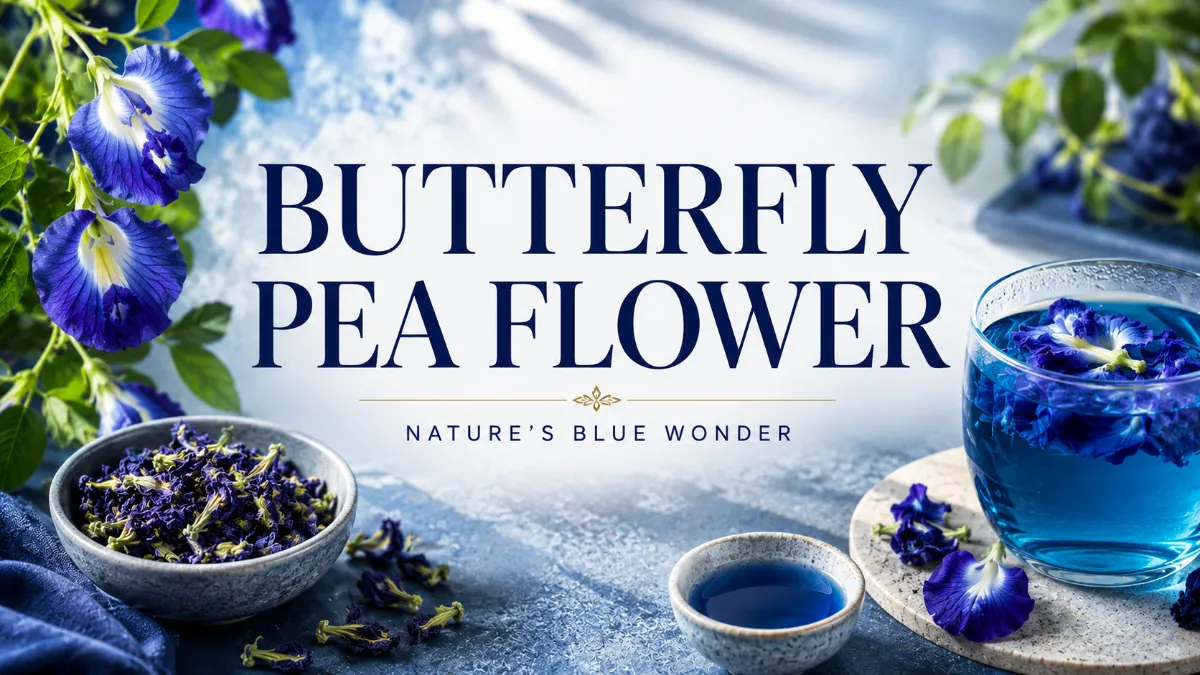
Butterfly pea flower is the vivid blue edible blossom of Clitoria ternatea, a tropical climbing vine. It is used to brew naturally caffeine-free blue tea, colour rice and desserts, and create drinks that turn purple or pink with lemon or lime. Its main appeal is culinary: gentle flavour, striking natural colour and a simple pH-driven transformation. While the flower contains plant pigments and other compounds under study, it should be enjoyed as a food or beverage—not as a treatment for illness.
Butterfly Pea Flower Quick Facts
| Attribute | Details |
| Scientific name | Clitoria ternatea |
| Plant family | Fabaceae, the pea or legume family |
| Common names | Butterfly pea, blue pea, blue tea flower, Asian pigeonwings; often called aparajita in India |
| Plant type | Tropical climbing perennial vine |
| Native range | Widely cultivated and naturalised across tropical regions; its precise native range is described differently across botanical and horticultural sources |
| Flower colours | Blue is most common in culinary products; white and pale varieties also occur |
| Commonly used part | Flowers, fresh or dried |
| Caffeine | Naturally caffeine-free in a flower-only infusion |
| Flavour | Mild, lightly floral, earthy and subtle |
| Main culinary uses | Herbal infusions, rice, desserts, syrups, mocktails, cocktails and natural food colouring |
| Colour chemistry | Anthocyanin pigments create blue colour in water and shift toward purple or pink with acidity |
| Growing conditions | Warm-climate vine; generally grown as a perennial in frost-free areas and as an annual or container plant in colder climates |
What Is Butterfly Pea Flower?
Butterfly pea flower is the edible flower of Clitoria ternatea, a member of the Fabaceae family. In kitchens, it is valued mainly as a botanical colouring ingredient and a mild herbal infusion rather than a strongly flavoured tea.
Its deep indigo-blue pigment comes from anthocyanins, including a group called ternatins. Steeping the flowers in water produces a blue infusion. Adding lemon, lime or another acidic ingredient shifts the liquid toward violet, magenta or pink.
It is not the same as black tea or green tea from Camellia sinensis. A plain flower infusion contains no natural caffeine unless it is blended with ingredients such as black tea, green tea, matcha or yerba mate.
Read more: Butterfly Pea Flower
Nutritional Profile and Plant Compounds
A plain strained infusion is generally a very low-calorie drink when made without sugar, milk, syrups or creamers. There is no universal nutrition profile for brewed butterfly pea tea, however, because the quantity of flowers, steeping time, water volume and commercial formulations vary widely.
For this reason, it is more accurate to describe the plant’s principal compounds than to assign fixed calories, carbohydrates or vitamin values to every cup.
| Component | What it means in practice |
| Calories | A plain strained infusion contributes very little energy; exact values vary by preparation |
| Caffeine | None in a flower-only infusion |
| Anthocyanins | Blue pigments, including ternatins, that help create the tea’s characteristic colour |
| Polyphenols | Plant compounds found in the flowers and studied for antioxidant-related activity |
| Flavonoids | A broad group of plant compounds present in the flower’s phytochemical profile |
| Macronutrients | Little of the dried flower’s solid material transfers into strained tea; powders and whole-food recipes differ |
| Added ingredients | Sweeteners, milk, syrups and creamers determine most of the drink’s calories and carbohydrates |
A darker blue cup does not confirm a specific antioxidant amount or health outcome. It usually reflects more efficient pigment extraction, which depends on flower freshness, brewing time, water chemistry and the amount used.
Why Does Butterfly Pea Flower Change Colour?
Butterfly pea flower acts as a natural pH indicator. Its anthocyanin pigments change form as a liquid becomes more acidic or alkaline, producing different colours.
| Preparation condition | Typical colour range | Useful applications |
| Neutral water | Blue to indigo | Tea, iced tea, blue rice, ice cubes |
| Mildly acidic mixture | Violet or lavender | Berry drinks, floral teas and desserts |
| Lemon or lime juice | Purple, magenta or pink | Lemonade, mocktails and cocktail presentations |
| Coconut milk | Pale blue to lavender | Lattes, puddings and coconut desserts |
| Alkaline ingredients | Greenish or duller tones | Some baked goods; results can be unpredictable |
The final shade depends on infusion strength, acidity, temperature, light and other ingredients. Long heating, prolonged light exposure and strongly acidic or alkaline recipes can fade or shift the pigment.
Butterfly Pea Flower Tea: How to Brew It
Butterfly pea flower tea is a mild herbal infusion made by steeping whole dried flowers in hot water. It is easy to serve hot or cold and works especially well with citrus, ginger, mint, lemongrass, honey and coconut.
Basic blue tea recipe
Ingredients
- 5 to 10 dried butterfly pea flowers
- 250 ml hot water
- Sweetener, optional
- 1 to 2 teaspoons lemon or lime juice, optional
Method
- Add the dried flowers to a cup or teapot.
- Pour hot water over them.
- Steep for 5 to 10 minutes, until the tea becomes blue.
- Strain if preferred.
- Sweeten to taste.
- Add lemon or lime gradually for a purple or pink colour change.
Use about 5 flowers for a lighter infusion and 8 to 10 for a deeper colour. Extra flowers intensify the appearance more than the flavour.
Iced and cold-brewed tea
For iced tea, brew a concentrated batch using 10 to 15 flowers per 250 ml hot water. Cool it, then pour over ice and dilute with cold water or sparkling water.
For a cold brew, combine 10 flowers with 300 ml cold drinking water and refrigerate for 6 to 12 hours. Strain before serving. Cold brewing develops colour more slowly and often produces a softer flavour.
Can you microwave butterfly pea tea?
Yes. Reheat prepared tea in a microwave-safe cup in short intervals. Avoid prolonged boiling because high heat can dull the anthocyanin colour. Do not microwave sealed containers, and handle hot liquid carefully.
Practical Recipe Ratios
These quantities are flexible starting points. Brew the blue base first, then add citrus near serving time if you want the visible colour change.
| Recipe | Starting ratio | How to use it |
| Colour-changing lemonade | 10 flowers + 250 ml hot water + 250 ml chilled water + 1 to 2 tbsp lemon juice | Brew and cool the blue base, sweeten if desired, then add lemon slowly |
| Coconut latte | 8 flowers + 150 ml hot water + 150 ml warm coconut milk | Brew concentrated tea, strain, then combine with milk |
| Blue rice | 15 to 20 flowers + 375 ml hot water for about 2 cups uncooked rice | Steep, strain and use the blue liquid as part of the cooking water |
| Simple syrup | 15 flowers + 250 ml water + 200 g sugar | Steep flowers, strain, dissolve sugar in the warm liquid, then cool |
| Blue mocktail base | 10 flowers + 200 ml hot water | Chill, pour over ice, add soda and citrus immediately before serving |
| Baking liquid | 8 to 12 flowers + 120 ml hot water | Use the strained infusion to replace part of a recipe’s liquid; test colour first |
Citrus makes the infusion purple or pink. Baking soda may push the colour greener, while yogurt, vinegar and lemon can create lavender to purple shades. If bright blue baking results matter, test a small batch before scaling up.
Culinary Uses Around Asia
Butterfly pea flower has an established culinary role across South and Southeast Asia. It lends colour to drinks, rice, desserts and modern café-style recipes without relying on synthetic blue dyes.
- In Thailand, butterfly pea drinks are often served with lime, and the infusion is used to colour rice and sweets.
- In Malaysia, bunga telang gives dishes such as nasi kerabu their distinctive blue rice.
- In Indonesia, bunga telang appears in drinks, rice preparations and contemporary desserts.
- In Vietnam, it is used in colourful beverages, jellies and dessert-style dishes.
- In Sri Lanka, it may be brewed as a herbal drink or used as a natural kitchen colourant.
- In India, blue aparajita flowers are used in herbal infusions and naturally coloured recipes, though common names vary by region.
Use only food-grade flowers intended for consumption. Ornamentals sold for gardening may have been treated with pesticides or other products unsuitable for edible use.
Butterfly Pea Flower Benefits: Understanding the Evidence
Butterfly pea flower contains anthocyanins and other polyphenolic compounds. It is an interesting subject for food-science research, but health claims should reflect the strength and limits of the evidence.
Human research
A small controlled study found that a Clitoria ternatea flower beverage consumed with sucrose affected post-meal glucose and insulin responses in healthy participants. Another small randomized study in overweight and obese men found that 2 g of a flower extract taken with a high-fat meal was associated with lower post-meal triglyceride exposure and changes in antioxidant-status markers; it did not find a significant difference in post-meal glucose between groups.pubmed.ncbi.nlm.nih
These results are promising but preliminary. The studies were small, short-term and used specific preparations that may not match ordinary tea, dried flowers, powders or commercial extracts. They do not establish a treatment for diabetes, high cholesterol, obesity, inflammation or other chronic conditions.
Animal research
Animal studies have explored Clitoria ternatea extracts for metabolic, inflammatory, neurological and other outcomes. Such studies can help identify research questions, but animal responses, doses and extract forms cannot be assumed to apply to people.
Laboratory research
Laboratory studies show that butterfly pea compounds can display antioxidant-related activity and other biological effects under controlled conditions. These experiments help explain the flower’s chemistry, but they cannot show that drinking the tea prevents disease or produces a clinical benefit.
Traditional use
The plant has a history of traditional use in several regions. Traditional use is valuable cultural context, but it is not equivalent to evidence that a preparation treats a specific condition.
A practical beverage benefit
A plain, unsweetened cup can be a caffeine-free alternative to sugary drinks or caffeinated beverages. This is a practical dietary choice, not a therapeutic effect. The nutritional profile changes substantially when the drink includes syrup, sweetened condensed milk, sugar or creamers.
Butterfly Pea Flower vs Other Colourful Drinks
| Ingredient | Natural colour | Caffeine | Flavour profile | Main use | Colour behaviour |
| Butterfly pea flower | Blue | No | Mild, floral and earthy | Tea, rice, desserts and colour-changing drinks | Turns purple or pink with acid |
| Hibiscus | Ruby red | No | Tart, fruity and floral | Tea, iced drinks and syrups | Naturally red to pink; acidic |
| Matcha | Green | Yes | Grassy, savoury and slightly bitter | Tea, lattes and baking | Green from chlorophyll; no citrus colour-change effect |
| Chamomile | Pale yellow | No | Floral and apple-like | Herbal tea | Flavour-focused; not used as a blue colourant |
| Spirulina | Blue-green | No | Earthy and marine | Smoothies, frostings and cold foods | Can be sensitive to heat and acid |
“Blue matcha” is a marketing term often applied to butterfly pea flower powder. It is not true matcha, which is made from ground green tea leaves and naturally contains caffeine.
Flowers, Powder, Tea Bags or Extract?
The right format depends on whether you want a clear drink, strong colour, visible petals, convenience or concentrated natural colouring.
| Format | Colour intensity | Flavour | Convenience | Storage expectation | Best use |
| Whole dried flowers | Medium to high | Mild and clean | Moderate | Best quality commonly lasts 12 to 24 months unopened; follow the label | Tea, rice, clear drinks and garnish |
| Butterfly pea flower powder | High | More vegetal; may leave sediment | High | Usually best used before the labelled date and protected from moisture | Smoothies, lattes, batters and frosting |
| Tea bags | Low to medium | Depends on the blend | Very high | Follow package date | Fast single-cup tea |
| Butterfly pea flower extract | High to very high | Usually subtle at low amounts | High, but requires careful measurement | Product-specific | Natural food colouring, drinks and baking |
Quick decision guide
Choose whole dried flowers for clear tea, traditional infusions and visually appealing drinks.
Choose butterfly pea flower powder for smoothies, lattes, batters, frosting and recipes where sediment is acceptable.
Choose tea bags when convenience matters most.
Choose a food-grade butterfly pea flower extract when you need strong, consistent colour and can follow the product label precisely.
How to Buy Quality Butterfly Pea Flower
Choose products with clear botanical identification and food-safety information rather than dramatic wellness promises.
- Check that the label identifies Clitoria ternatea.
- Select flowers, powders or extracts described as food-grade or culinary-grade.
- Look for dry, mostly intact blue flowers without dampness, mustiness or visible mould.
- Prefer sealed, light-protective packaging with a full ingredient list, batch information and best-before date.
- If organic certification matters to you, look for certification recognized in your market rather than an unsupported “organic” claim.
- Consider brands that disclose product origin, harvest handling, storage practices and contaminant testing where available.
- Avoid supplements or teas promoted as cures, detoxes or substitutes for medication.
- Do not consume flowers from ornamental plants unless you know they were grown without unsuitable pesticides or treatments.
Deep blue flowers can produce a stronger infusion, but colour alone does not confirm purity, freshness, pesticide status or a precise anthocyanin concentration.
Storage, Freezing and Product Lifespan
Store dried flowers in an airtight container in a cool, dry, dark cupboard. Keep them away from moisture, direct sun and heat sources such as stoves.
- Unopened dried flowers: Use by the manufacturer’s best-before date; many products are labelled for 12 to 24 months when properly packaged.
- Opened dried flowers: For best colour and flavour, aim to use within 6 to 12 months while following the package date.
- Powder: Keep tightly sealed and always use a clean, dry spoon.
- Prepared tea: Refrigerate promptly in a covered container and use within 2 to 3 days.
- Frozen tea: Freeze a concentrated infusion in ice-cube trays for use in drinks. Use within a few months for the best colour.
Discard any product that smells musty, looks mouldy, feels damp or unusually clumped, contains insects or produces an off-smelling infusion.
Common Problems and Solutions
| Problem | Likely cause | Solution |
| Tea is pale rather than blue | Too few flowers, old flowers, short steeping time or excess dilution | Use 8 to 10 flowers per cup, steep longer or replace stale flowers |
| Tea looks greenish | Alkaline water or ingredients, including baking soda | Use neutral water and avoid alkaline ingredients when blue is the goal |
| Tea looks gray or dull | Old flowers, prolonged heating, light exposure or incompatible ingredients | Brew fresh, avoid extended boiling and store flowers in the dark |
| Blue colour fades quickly | Heat, light, oxygen or acid exposure | Keep the blue base cool and covered; add citrus just before serving |
| Powder settles in the cup | Powder does not dissolve completely | Whisk, blend or choose whole flowers for clear drinks |
| Rice is lightly coloured | Infusion was too weak or diluted | Make a more concentrated tea and use it as more of the cooking liquid |
| Cake loses its blue colour | Baking heat and pH changed the pigments | Test a small batch and expect violet or lavender tones in many baked recipes |
| Tea stains hands or fabric | Concentrated pigment contacted a porous surface | Rinse promptly with cold water and wash fabric according to its care label |
Safety and Sensible Use
Butterfly pea flower is commonly used in normal culinary amounts and ordinary herbal infusions. In the United States, butterfly pea flower extract is permitted as a colour additive for specified food categories. The regulated additive is a dark-blue liquid produced by aqueous extraction of dried Clitoria ternatea flowers.ecfr
This food-colouring status does not mean that every tea, powder or supplement has been proven to treat disease, and it does not make different product forms interchangeable.
- Pregnant or breastfeeding people should consult a qualified healthcare professional before using it regularly, especially as a powder, extract or supplement.
- People taking prescription medicines—particularly medicines affecting blood glucose, blood pressure or blood clotting—should ask a doctor or pharmacist before frequent use of concentrated products.
- Anyone with a plant or legume allergy should use caution and stop use if symptoms such as rash, swelling, wheezing, vomiting or diarrhoea occur.
- Children should have only normal food-level amounts unless a paediatric clinician advises otherwise.
- Do not intentionally give butterfly pea tea, extracts or supplements to dogs or cats. Veterinary evidence for routine use and safe quantities is limited.
- Use only food-grade flowers. Avoid using roots, seeds, pods or unidentified plant material.
Can You Grow Butterfly Pea Flower?
Butterfly pea is a tropical climbing vine that needs warmth, bright light, well-draining soil and a support structure such as a trellis. It can be grown as a perennial in frost-free climates or in containers where it can be protected from cold weather.
Basic growing guidance
- Start with seeds from a reputable supplier and follow the packet instructions.
- Use a pot with drainage holes or a well-draining garden bed.
- Provide a trellis, fence or other climbing support.
- Give the vine plenty of light; outdoor full sun generally supports stronger flowering.
- Water consistently without allowing the roots to sit in waterlogged soil.
- Harvest only flowers from plants grown without pesticides or treatments unsuitable for edible crops.
- Dry fully before storing flowers for tea.
Sustainable sourcing
Choose transparent food suppliers that provide clear information about origin and handling, and avoid unnecessary single-use packaging where practical. Home growing can reduce transport and packaging needs, but only harvest what you can use or dry safely. As a legume, the plant can form nitrogen-fixing associations with soil bacteria, though the gardening benefit varies with growing conditions.
Frequently Asked Questions
Is butterfly pea flower the same as blue matcha?
No. “Blue matcha” commonly refers to butterfly pea flower powder, while true matcha is powdered green tea made from Camellia sinensis. Butterfly pea powder is naturally caffeine-free and can make blue or purple drinks. Matcha contains caffeine, has a green colour and tastes grassy or savoury. The ingredients also behave differently in recipes: butterfly pea pigments change colour with citrus, whereas matcha does not produce the same pH-based effect.
Can you reuse butterfly pea flowers for a second cup of tea?
Yes, whole dried flowers can usually be steeped a second time. The second cup will be paler and milder because most of the blue pigment is extracted during the first brew. Add a few fresh flowers if you want a stronger colour. Reuse flowers only when they have been handled cleanly and have not been left in brewed tea at room temperature for a long time. Discard them if they smell off or look degraded.
Does boiling butterfly pea flower destroy the colour?
Hot water extracts the blue pigment effectively, but prolonged boiling can reduce colour stability and make the shade look duller. For tea, pour hot water over the flowers and steep rather than boiling them for a long time. In cooked foods, the final colour also depends on acidity, alkalinity and other ingredients. Test a small batch when colour is important, especially for baking, where heat and batter pH can shift blue toward lavender, purple, greenish or gray tones.
Can butterfly pea flower tea be frozen?
Yes. Brew a strong infusion, cool it promptly and freeze it in clean ice-cube trays or a covered freezer-safe container. Blue tea cubes work well in sparkling water, lemonade and mocktails. For the most vivid result, use them within a few months because colour can fade gradually in storage. Add lemon or lime after serving if you want the cubes or drink to shift toward purple or pink.
Why is my butterfly pea tea green instead of blue?
A greenish tea often means the water or recipe contains alkaline ingredients, such as baking soda, that affect the anthocyanin pigments. Mineral-rich water, old flowers and ingredient interactions can also create green-gray or dull shades. Brew fresh flowers with neutral water when possible, avoid alkaline ingredients and prepare a blue base before adding other components. Add lemon only after you achieve the desired blue colour, because acid will change it toward purple or pink.
Is butterfly pea flower FDA approved?
In the United States, butterfly pea flower extract is permitted for use as a colour additive in specified food categories. This is different from approval as a medicine or validation of every health claim made for tea, powder or supplements. The permitted additive is made by aqueous extraction of dried flowers. Product labels, intended use and serving guidance still matter, especially for concentrated extracts.
Can dogs or cats drink butterfly pea flower tea?
It is best not to intentionally give butterfly pea tea, powders or extracts to dogs or cats. Reliable veterinary guidance on regular use and safe amounts is limited, and blends may contain ingredients that are unsuitable for pets. If a pet consumes a small amount accidentally, monitor it and contact a veterinarian for specific advice—particularly if it consumed a concentrated product, is very small, has a health condition or develops vomiting, diarrhoea, lethargy, swelling or breathing changes.
Can butterfly pea flower be grown indoors?
Yes, it can grow indoors in a large container if it receives strong light, warm temperatures, well-draining soil and a climbing support. Indoor plants may flower less heavily if light is inadequate. Grow edible flowers only without pesticides or pest-control products unsuitable for food crops. In colder regions, containers are also useful because the vine can be moved indoors before frost. Start with seeds intended for home growing and follow their specific germination guidance.
How do you make butterfly pea flower rice?
Steep 15 to 20 dried flowers in about 375 ml hot water for 10 minutes, then strain the blue liquid. Use this infusion as part of the cooking water for roughly 2 cups of uncooked rice, adjusting total liquid for the rice variety and method. The rice will take on a blue colour as it cooks. For a purple presentation, add citrus at the table or serve with a tangy condiment rather than acidifying the cooking water before cooking.
Does butterfly pea flower tea have calories or carbohydrates?
Plain strained flower tea contributes very little energy because it is mostly water, but a universal calorie or carbohydrate figure is not established for every preparation. The amount of flower, steeping time and whether the drink includes powder all affect the result. In practice, added sugar, honey, milk, syrups and creamers have the greatest effect on calories and carbohydrates. A powder-based drink may contain more plant solids than a strained infusion and should be evaluated according to its product label.
