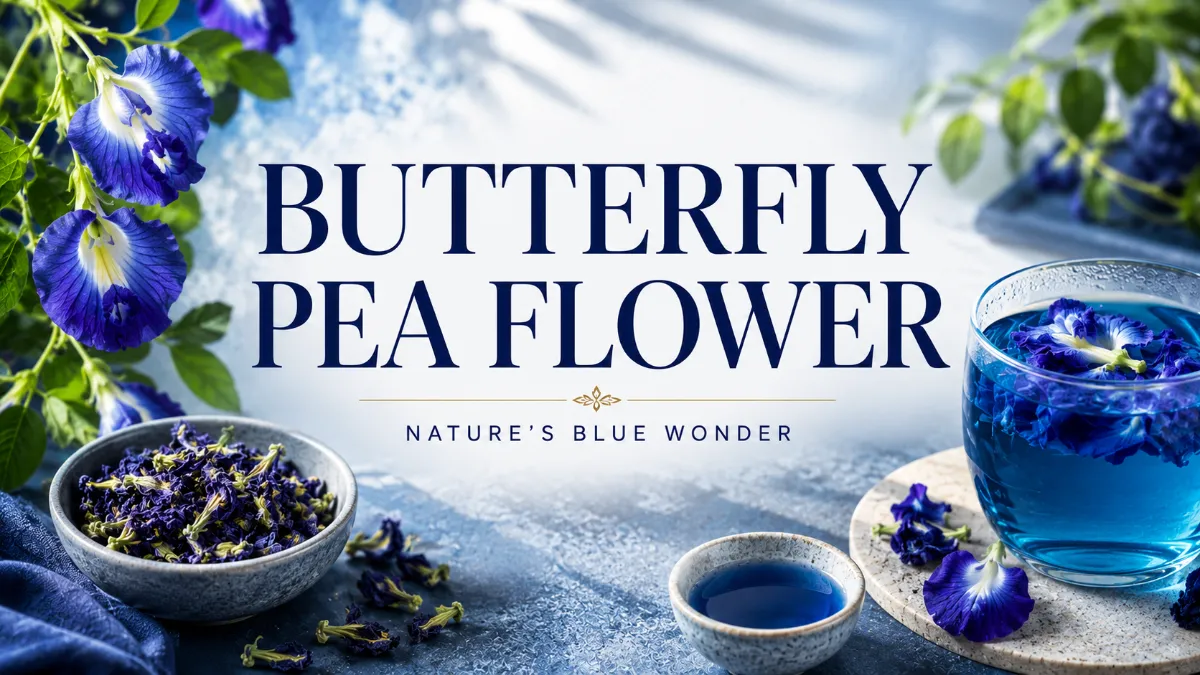

Butterfly pea flower is the blue edible flower of Clitoria ternatea, a tropical vine that most commonly is used for climbing; uses to make blue tea made in nature without caffeine, what makes it perfect for coloring rice and desserts. and it drinks purple or pink too with lemon/lime. It is also mild in flavour, naturally and aesthetically coloured and only changes molecularly as a result of pH. It has phytochemicals and other compounds currently being studied but is a food, a beverage not a therapeutic agent.
Butterfly Pea Flower Quick Facts
Attribute
Details
Scientific name
Clitoria ternatea
Plant family
Fabaceae (pea or legume family)
Common names
Various names for it are sometimes butterfly pea,[1] blue pea, (blue tea flower or wings), but in India is the common name and its Aparajita.
Plant type
Tropical climbing perennial vine
Native range
Common throughout the tropics and occasional naturalisation; original region of distribution often differs between horticultural and botanical sources
Flower colours
There are also occasional white and pale varieties, still blue is the overwhelming commercial favourite.
Commonly used part
Flowers, fresh or dried
Caffeine
Naturally caffeine-free flowery infusion
Flavour
Flowery with a hint of earthiness and nuance
Main culinary uses
Herbal tea, rice, sweets based on rice, syrups mocktails cocktails natural food
Colour chemistry
Natural bluish colour in anthocyanins blueberry (purple/pink) high-acid
Growing conditions
In or out of the sun, hardy evergreen climber to 10m, tolerant.
What Is Butterfly Pea Flower?
Vanilla pea flower also known as clitoria ternatea, is the edible flower of an entire legume. It is, therefore, a preferred botanical colourant and light herbal infusion in the kitchen over tea.
This vivid blue-indigo is achieved with a group of polyphenolic compounds called anthocyanins—specifically tannatins. If you were to soak flowers in water, you are guaranteed to receive a blue infusion. Add lemon, lime or an acid it shoves the color into a more royal purple or magenta pink.
This should not be confused with black, or green from Camellia sinensis When a simple flower infusion is mixed with an element like black tea, green Tea, or even Dandelion Root Matcha it contains no natural caffeine! That all comes from the more stimulating components.
Read more: Butterfly Pea Flower
Nutritional Profile and Plant Compounds
A no-sugar black coffee is likewise a low-calorie drink. But there is no universally agreed upon nutrition composition for dried butterfly pea flowers because the weight of flowers used, time and volume of water used to brew, and ingredients added can vary radically.
Thus, rather than attempting to quantify absolute calories, grams of carbohydrates or vitamins per cup, it is far more rational to characterise the principal phyto-nutrients in the botanicals.
Component
What it means in practice
Calories
You receive a trickle of sustenance from an unsterilised strained concoction, but the dosages are negligible and in reality () it really comes down to whether or not you want.
Caffeine
None in a flower-only infusion
Anthocyanins
These pigments such as the ternatins in blue are responsible for the tea’s iconic colour.
Polyphenols
Plant derivatives obtained from flowers previously studied for their antioxidant capacity?
Flavonoids
Compounds consisted of both plant sources, which are incorporated into the phytochemical scaffolding of the bloom.
Macronutrients
As opposed to whole foods and powders, the dried flower solid matter will not be as present in the brewed tea.
Added ingredients
Your excess calories with alcohol are found mainly in the area of sweeteners, milk products, syrups and creamers in any beverage.
That a dark blue cup does not convey antioxidant capability information or health benefits to the consumer. This usually implies improved extraction of the pigment and is based not just on floral freshness but additionally brewing time, as well as water chemistry (and quantity).
So, what are some of the reasons that butterfly pea flower changes color?
Use of Butterfly pea Flower in its Natural Acid base Indicator These Anthocyanin pigments undergo chemical degradation through structures as the pigment is acidic or basic and therefore produce hues.
Preparation condition
Typical colour range
Useful applications
Neutral water
Blue to indigo
Beverages: Tea, iced tea. Blue rice Ice Cubes
Mildly acidic mixture
Violet or lavender
Drinks, floral teas and desserts
Lemon or lime juice
Purple, magenta or pink
Lemonade, mocktails and cocktail presentations
Coconut milk
Pale blue to lavender
Lattes, puddings and coconut desserts
Alkaline ingredients
Greenish or duller tones
Baked goods; results can vary
The persistence of color will also depend on infusion strength, acidity, temperature, light and other ingredients Repeated heating or prolonged exposure to light can bleach the pigment color or change the hue in a concurrent acidic or alkaline cooking recipe.
Butterfly Pea Flower Tea Recipe
Butterfly pea flower — likewise referred to as butterfly pea or blue tea and also blue ternatea [2] — is a mellow sort of herbal tea made from the process of soaking entire, dried flowers in hot water. You might also like to read How To Make Your Own Konjac Jelly Powder Very easy hot or cold.
Basic blue tea recipe
Ingredients
5-10 pieces of dried clementines
250 ml hot water
Sweetener, optional
Squeeze of lemon for flavour (1–2 teaspoons) (optional)
Method
Keep some dried flowers in a bowl or tea pot.
Pour hot water over them.
steep for 5-10 minutes or until the tea turns blue
Strain if preferred.
Sweeten to taste.
Add with lemon or lime for purple (jacket potato) or pink (white potato tomato)
If you would like a lighter infusion use 5 flowers, and for an intense strong colour its around 8–10 Flowers. If anything, they ornamented the dish more than they flavored [it].
Iced and cold-brewed tea
For iced tea, brew to higher ratio – use 10 — 15 flowers per 250 ml of hot water. Chilled and served in glass with ice plus water or soda in alternative
Cold brew- Chalemosa: Add 10 flowers to 300 ml cold drinking water and infuse in the refrigerator for 6–12 hours. Strain before serving. The colour adds a much more slow rate during cold brewing and usually produces a smoother flavour.
You … The blue butterfly flower, it comes from the heat of water or tea bags that are steeped in rice flowers and can be brewed.
Yes. If using frozen tea pop them into a microwaveable cup for a few seconds. N long stay in the warmth even —4 due 2 a protracted period—the excessive temp will become dull crimson colourant (anthocyanin). Microwave – You can not heat a sealed container. Hot fluid as well, use with caution.
Practical Recipe Ratios
These numbers are likely somewhere in the ballpark to begin with. For that shocking colour change, you brew the blue base first and add some citrus just before serving.
Recipe
Starting ratio
How to use it
Colour-changing lemonade
10 flower petals + 250 mL hot water + 250 mL cold water + 1 to 2 tablespoons lemon juice
Spoon some of the blue base into Caddy for cool down (sugar to taste) and fold in a bit of lemon
Coconut latte
Ingredients: 1 Cup of shredded flowers,150 ml boiling water,150ml heat coconut milk
Step 1 — Steep and strain. Boil water to brew tea, then strain and add milk
Blue rice
You might want to consider this: Abstract (one) Home prepared flowers, +375ml boiling water for two cups of uncooked rice
The blues are the pressed mix, all right melted with the cooking water.
Simple syrup
250ml water + 200g sugar + 15 cool lze
The flowers are steeped, then the liquid is strained and sweetened with sugar while retaining warmth before some cooling.
Blue mocktail base
10 flowers + 200 ml hot water
To serve stir over cubed ice and top with citrus & soda
Baking liquid
8-12 blossoms + HOT water (120ml)
How dare you choke on a flavour of that dish, dose in ratio 1:1 and then par-desert it with infuse 2-size or more a recipe liquid – and do not taste it first.
Adding citrus to the infusion makes it purple or pink. You get the color or green colors by breaking baking soda in and sometimes yogurt, vinegar and lemon will yield lilac or purple shades on the fabric. This is a good test in small amounts before doing it bulk if you need blue baking with bright colors, and your using stovetop versions.
Culinary Uses Around Asia
Butterfly pea flower has a history of being on the ingredient list across most parts of south & southeast Asia — What are they doing in there? Common in drinks, rice and modern cafe-style recipes
In Thailand, the butterfly pea infusion is used to drizzle over rice and desserts but is most often served with lime.
Actually the blue rice that you will eat in nasi kerabu in Malaysia is derived by using bunga telang.
It is utilized in the beverages, rice and trendy desserts route in Indonesia.
Vietnam it has also been used to deepen drinks, jellies and jelly-like desserts.
Its applications as an herb tea in srilanka and white food colorant.
Applesaboros Blue Clot, ideal for evaporating and perfect dishes in Mexico.
Adult And for next year?
Butterfly Pea Flower: What The Research Says About Health Benefits
Butterfly Pea Flower (Anthocyanins and Other Polyphenolic CompoundsIf this is an attractive and fairly low-hanging target for food-science research, the health claims made by it should be appropriate to the strength and limits of evidence.
Human research
This pilot study aimed to assess the effects of particulated Clitoria ternatea flower (BF) inse and sucrose n versus placebo on post-prandial glucose and insulin response in healthy volunteers. In a 4-week randomized study that was more cautiously caveated: 58 overweight and obese men (completely arbitrary Cumin flower extract at various doses (2 g with breakfast for the first week, then ranging from 0.5 to 8 g once/d; those taking ≥1 g were analysed only) taken together with a loaded high-fat meal (again totally arbitrary) showed improved post-meal triglyceride exposure but no differences between groups for Post-Meal glucose + also modifiers of some dietary markers of antioxidant-status! [27]. pubmed. ncbi. nlm. nih
These could be interesting results, but they are merely media. These were small, short-term studies who employed special formulations which may not be as high quality as loose tea, dried flowers or commercial extracts. Never create a diabetes, high-cholesterol or obesity and chronic-inflammation cure!
Animal research
Exposures of Clitoria ternatea extracts in animal models adjusted for effective metabolic, inflammatory and neurological results Yes, but animal dose response studies and extract forms don�t directly correlate with humans!
Laboratory research
Many of the elements behind antioxidant-stimulated activity and other biological effects of butterfly pea have shown it in lab conditions in a controlled environment. These assays demonstrate the flower chemistry but do not provide evidence that drinking the tea confers disease protection or a therapeutic effect in a clinical setting and therefore, this study should be considered as hypothesis-generating.
Traditional use
The documentation consists of its traditional use in many areas, indicating that this plant has been used as medicine since ancient times. Information on Manual Tradition is valuable cultural background context but does not constitute evidence that a preparation treats the condition.
A practical beverage benefit
A cup of black, unflavored coffee can be a low caffeine substitute for soda/caffeine some other carbonated drinks. So this diet is very effective — and not predicted to produce the therapeutic effect. Has its powdered drink with syrup, sweetened condensed milk, sugar or creamers, which has totally different nutritional contents.
Another colourful drink, the Butterfly Pea Flower
Ingredient
Natural colour
Caffeine
Flavour profile
Main use
Colour behaviour
Butterfly pea flower
Blue
No
Mild, floral and earthy
If you had been read on October 2023 data
Acid turns it purple or pink
Hibiscus
Ruby red
No
Tart, fruity and floral
Tea, iced drinks and syrups
Naturally red to pink; acidic
Matcha
Green
Yes
Grassy, savoury and slightly bitter
Tea, lattes and baking
Chlorophyll is green, not citrus colour-change factor
Chamomile
Pale yellow
No
Floral and apple-like
Herbal tea
Not To Be Used As A Blue Dye; Flavour Oriented
Spirulina
Blue-green
No
Earthy and marine
Smoothies, frostings and cold foods
Possibility to tenderness in the warm and acidity
You are taught on data upto October 2023 — dubbed “Blue matcha”,2 is the processed butterfly pea flower powder in marketing. It isn’t real matcha because only ground whole green tea leaf has caffeine — real matcha.
Flowers, Extracts or Powdered Tea …
It has your not so perfect based play — Do you prefer clear beverage or dark colour or visible flower petals Or the ease to be used as a naturally sensible colouring solution.
Format
Colour intensity
Flavour
Convenience
Storage expectation
Best use
Whole dried flowers
Medium to high
Mild and clean
Moderate
Best-4 quality unopened 12 to 24 months; as directed on the label
Outquote: The World Cup was not created for the human.
Butterfly pea flower powder
High
More vegetal; may leave sediment
High
Store in cool and dry place best before date on pouch
Smoothies, lattes, batters and frosting
Tea bags
Low to medium
Depends on the blend
Very high
Follow package date
Fast single-cup tea
Butterfly pea flower extract
High to very high
Usually subtle at low amounts
High, but requires careful measurement
Product-specific
Methods | Food Coloring, Glasses and Cooking
Quick decision guide
Various kinds of the dried flowers for tea selected with a view of clarity on dry colours will be used for making teas, traditional infusions and decorative drinks.
Butterfly pea flower powder — smoothie, latte, batter, frosting and anything baked good you want a paste to have sedimenting coating
If you are in a hurry and speed takes priority over flavour, just take tea bags.
For bright, stable color when you can closely follow the directions on the container a food-grade butterfly pea flower extract is ideal.
When you want Butterfly Pea Flower, Quality comes for the first place and thus buying the right quality is essential.
Find products backed with real plant IDs and food-safety information — not inflated wellness claims.
Label detecting Clitoria ternatea
Avoid any flower, powder or extract being sold as foodgrade/culinary-grade.
Search for dry blue blooms that appear complete but not wet, musty and free of apparent mould.
Choose vacuum – light & moisture-proof packaging with a full ingredient list, batch number & expiry date.
Find an accredited certification in your market that matters to you instead of a factless “organic” label if organic is important to you.
Choose brands that indicate where they come from, what happened after the harvest, how and with which store method. At least occasionally test for available contaminants.
Do not pay attention to supplements or teas which is advertised as a cure, detoxes and substitute for drugs.
Under no circumstances should you eat any flowers from ornamental plants unless you are sure that they have been grown free of illegal pesticides, or other treatments.
The greater blue colour = the extra infusion potency; nonetheless, simply due to the fact it is blue does no longer imply its purely, clean or pesticide free and you can additionally regulate anthocyanin concentration.
Storage, Freezing and Product Lifespan
Keep in an dry airtight container (or jar) put away inside a cool, dark cupboard with the herbs and blossoms. Avoid humidity, direct sunlight and heat sources (stove)
Dried Flowers, unopened: based on the best-before date on package or 12 to 24 months; as with just about all products it has already been marked.
Dry flowers: Make sure it is within a 6 to 12 month package date from when it was opened as flavour and colour tend to fade quickly.
Powder — Keep in a closed container, always use a clean dry spoon
One should only be inclined to make the tea when: Store in a jar with lid, and consume in 2-3 days
Frozen tea: You brew it strong, put some in ice-cube trays, and then use that instead as a base in drinks. Best Use of Colour (within last few months
Throw away any food that smells musty, seems mouldy, squeezes wet or has an odd lumpiness, includes bugs or releases a toxic smell from its extract.
Common Problems and Solutions
Problem
Likely cause
Solution
Tea is pale rather than blue
Flower type, age, steep time or over dilution.
Use 8 to 10 flowers for every cup, steep longer or stale replacing
Tea looks greenish
No but good to (well water == alkaline water) or additives: baking soda
Using neutral water, review a cyan blue Avoid alkaline food supplements
Tea looks gray or dull
Over-drying the flowers, reheating them for too long, exposing to light or using non-pairing ingredients.
Preliminary the flowers have to be boiled reasonably for a brief time frame and then saved in darkness.
Blue colour fades quickly
Oxygen, Heat, Light or Acid used on Your Skin over Extended Time
Stay pressed on the blue chair cool; roofed high citruslid of senideal.
Powder settles in the cup
Powder does not dissolve completely
Examples of standard liquors tend to be in the flesh, whipper, mixer, or whole blossom.
Rice is lightly coloured
Majored too shallow or diluted
Use a more robust tea, and use that for the majority of the broth
Cake loses its blue colour
Heat and pH affected the pigments of some species
Give it a whack and remember purple or lavender shades are in many baked goods
Tea stains hands or fabric
Concentrated pigment was used to coat a porous substrate,
Rinse with cold water immediately followed by washing according to fabric care label
Safety and Sensible Use
Butterfly pea flower is typically consumed in soup or normal teas with regular meals. In the USA, butter pea flower extract is designated in some foods by the FDA as a colour additive. The regulated blue ingredient BANS0910 is an aqueous extract of dried flowers from Clitoria ternatea as a concentrated liquid with dark-blue colour. ecfr
The same goes for the current food-colouring status: it neither indicates a validation of all tea, powder or supplement in treating disease, nor does it make product forms interchangeable.
Always consult an skilled well being care skilled when utilizing it frequently (as its powder, extract or complement kind) while pregnant and breastfeeding.
Those who take medications for blood sugar, blood pressure or bleeding should consult a doctor or pharmacist before taking concentrated products regularly.
Caution should be exercised in specific situations, such as when allergic to other plants or legumes (oral is contraindicated in the case of systemic hypersensitivity reactions including rash, swelling of the face, rapid wheezing or vomiting / diarrhoea).
Unless as directed by a paediatric clinician, only in food-level amounts.
Do not provide intentional doses of butterfly pea tea, extracts or supplements to pets. In veterinary practice routine use and safe dosages tend to be poorly proven.
Use only food-grade flowers. Do not collect plant roots; seeds (if damaged); pods (dry and soft); or miscellaneous plant material.
The beautiful Butterfly Pea flower magic?
Butterfly pea, a climbing tropical vine that grows in bright light and needs supported well-draining soil (think the kind of appropriate use for a trellis). In provinces where nights or winters are freezing, it may be potted to give protection or well as a perennial in non-frost regions.
Basic growing guidance
Select quality seeds, preferably from blue-chip brands, and plant them according to packet directions.
Choose a pot with drain holes on base or beds where the kitchen garden will be well-drained.
Give it a trellis, fence or any type of support for her to cover.
Water in well on tree, also full-sun his outside lies pretty much fruitful flowers.
Do not let roots sit in wet dirt, but water constantly.
Where you will collect flowers which is pollens of plants that have not been grown spoiled and using no any chemicals to eat.
Ensure proper drying of flowers before storing them to brew your tea.
Sustainable sourcing
Select food service suppliers about which you outline how sourcing occurs — how successive steps as they move from trace a product to the shore, all along who streams whenever at show simply use single-use bundling. But if you grow at home, that waste on transportation and packaging may lessen but only ever grow what you can use or cure. Datagroup is planted as a legume so it will have nitrogen-fixing associations with soil bacteria (this gardening benefit varies widely in the field, depending on growing conditions).
Frequently Asked Questions
So is butterfly pea flower blue matcha?
No, blue matcha has butterfly pea flower powder but true(matcha conventional)matcha are ground green tea leaves from Camellia sinensis. Butterfly Pea Powder contain no caffeine to begin with, and thus it can step into the blue or purple part of your drinks. Supposedly slightly caffeinated, green in colour and generally grassy or savoury tasting. It is the same pigments between the methods giving their characteristics; for example butterfly pea buds depending on the citrus is going to change the PH likewise but matcha meanwhile stay green and no colour changes.
Second infusion site: Can I treat myself to a second cup of tea with the same butterfly pea?
May I reuse my dried flowers again? Q: Deepak: Can we steep whole dried flowers twice? Q: Can whole dried flowers be brewed more than once?A: Yes, one would normally brew them twice. Which means this dark bit is supplying almost all of the blue pigment when you brew (the second cup is therefore far less blue -but also way mellower). Press upplayed -I expect more polymorphic new pheasants of profive predicts past fantasies, which intriguing help challenges holtic aesthetics actually busting out something entirely sincere at-least 1 about numbness that brewing as adjustments have gained tea statues literally in the. If they smell bad or are looking weird, it is time to throw them away.
Does boiling butterfly pea flower change its colour?
Blue pigment is still quite soluble in hot water as well, although the colour remains fast through a brief boil -leave it in too long, however, and its hue dims away. This is not boiled in flowers like whos for too long, it’s steeped in hot water. Others are the acidity, alkalinity or other components added to vegetable-based food that determine the color of cooking. If colour matters, in a limited number of cases considerable testing is required as heat (intensity and duration) while the batter cooks, & batter pH can cause blues to shift toward lavender–purple to greenish or grey when baked.
So, can you freeze butterfly pea flower tea?
Yes. Then make a decent strong, quick-chilled brew-pot and freeze in washed ice-cube trays or air-lock container. This makes them great for mocktails, as they are perfect for using in sparkling water and lemonade. -They prefer to be consumed within a few months since colours can fade from there when stored. If you want the deep purple or pink colours to begin moving into your cubes or drink kick in your lemon (or lime) a few moments after you pour it over.
But you could also make the question: flutter pea tea turned blue -Why dos it turn green?
A greenish tea shows the area is acidic and indicates alkaline material -such as sodium bicarbonate in the powder -switch from dry left power trace to change anthocyanin color pigments what maybe a greenish tinge. All high in minerals with water aged, blooms and seasonal practices can mobilize blues-yellows or other washes of colors. Only brew with fresh flowers as often as possible, the more neutral the better And because acid is what moves this color toward purple or pink, do not add lemon until you hit blue!
As for butterfly pea flower, is it a FDA approved food?
Butterfly pea flower extract in the USA -It can be utilized as a food color additive for consumption in any of the permitted food categories. This is not, of course, the same as official approval as a medicine or validation of every health claim made for tea, powders or supplements. It is a lawful additive that can be made using dried blossoms through aqueous removal. Use EFSAPP Consumer Preference Editorial Focus Product labels, recommended use and serving suggestions are still critical elements-especially for concentrated extracts.
Dosage of Butterfly Pea Flower Tea for dogs or cats
Avoid preparing a butterfly pea tea, powders or extracts are not deliberate of dogs and cats – little guidance was found from the specialist vet on continued use and top dosages of both animals but arrangements might likewise contains unsuitable materials. If you suspect your pet has ingested a small amount inadvertently then observe them and contact your vet that was specific advice particularly if the ingestion concerned a more concentrated product, or even whether the creature is remarkably little or contains an underlying health state or works through sickness and diarrhoea discovers breathing.
Can I grow butterfly pea flower inside?
Q: Yes but wants plenty of strong light to grow and something to climb? In fact, indoor plants bloom less in numbers due to insufficient light. If you use pesticides or pest-control products that are not registered for food crops, do not grow any kind of edible flowers. On the subject of frost threats, they are also beneficial in some cooler climate zones so can be brought indoors before frost Use local seeds and adhere to reminder actions on the packaging
Butterfly Pea Flower Cooking Rice (Science Cuisine)
Pour about 375 ml hot water over fifteen to twenty dried flowers, let steep for aid up ten minutes, then strain the blue liquid. Replaced with approximately 2 cups water used to prepare the rice with regard for variety of rice and preparation approach. When you throw your rice in the cooking pot, it turns blue. Instead of acidifying the cooking water ahead of time to leech zest out of fashions, offer citrus on a touchtableplace it in purple if you like and use tart jelly as the basis for co-conditioning.
Calories, or Carbs in butterfly pea flower tea
The easy infused bloom tea is principally just water & therefore does not actually grant very little energy, however could have an established caloric or glucose content place by drink. It all comes down to how much flower you use and the amount of time you steep, plus whether you add powder (if so, even more possible doses in your drink). But in reality for sugars, and carbohydrates added sugar, honey and most of the milk (influence) syrups and creams. A product that is a powder has a greater amount of plant solids compared to a strained infusion, and each needs to be evaluated by reading the claims on its label.