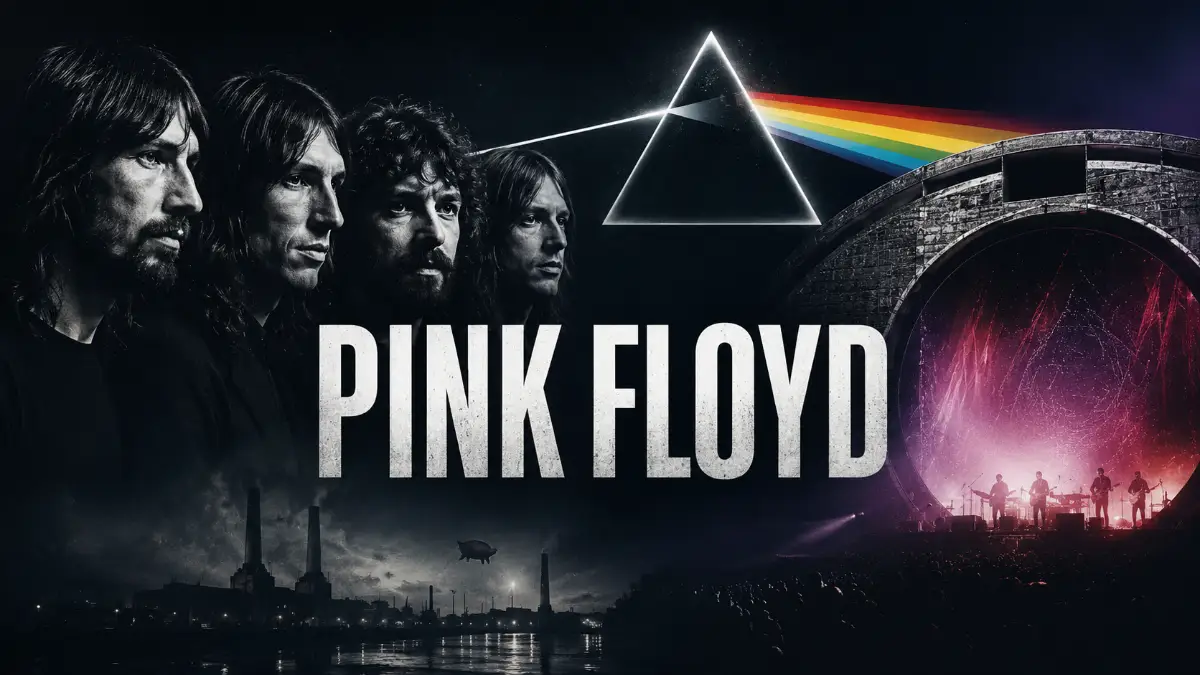
Pink Floyd were an English rock band whose work transformed psychedelic rock, progressive rock, album production, and concert spectacle. Their landmark catalog—especially The Dark Side of the Moon, Wish You Were Here, Animals, and The Wall—combines memorable melodies with ambitious themes about time, war, alienation, power, mental strain, wealth, and human connection.
Formed in London in 1965, the band evolved from Syd Barrett-led psychedelia into one of music’s most influential album acts. Pink Floyd’s music continues to reward both casual listening and close attention: individual songs are often immediate, while the greatest records work as carefully designed emotional and sonic worlds.
Pink Floyd Quick Facts
| Fact | Details |
| Origin | London, England |
| Formed | 1965 |
| Genres | Psychedelic rock, progressive rock, art rock, space rock |
| Main active period | 1965–1995 |
| Studio albums | 15 |
| Best-known album | The Dark Side of the Moon (1973) |
| Classic lineup | Roger Waters, David Gilmour, Richard Wright, Nick Mason |
| Original frontman | Syd Barrett |
| Only continuous member | Nick Mason |
| Major honor | Rock & Roll Hall of Fame induction, 1996 |
| Signature songs | “Time,” “Money,” “Wish You Were Here,” “Comfortably Numb,” “Another Brick in the Wall, Part 2,” “Shine On You Crazy Diamond” |
Who Were Pink Floyd?
Pink Floyd were not built around a single frontman or one dominant musical voice. Their defining work came from the friction and collaboration between Syd Barrett’s early surrealism, Roger Waters’s concepts and lyrics, David Gilmour’s guitar and melodic instinct, Richard Wright’s keyboards and harmony, and Nick Mason’s restrained rhythmic foundation.
| Member | Primary role | Contribution |
| Syd Barrett | Guitar, vocals, songwriter | Created the band’s early psychedelic identity and wrote much of its first major material |
| Roger Waters | Bass, vocals, songwriter | Principal lyricist and conceptual leader during the 1970s |
| David Gilmour | Guitar, vocals, songwriter | Signature guitar tone, major lead vocalist, melodic co-writer |
| Richard Wright | Keyboards, vocals, songwriter | Piano, organ, synthesizers, harmony, and spacious arrangements |
| Nick Mason | Drums | Rhythmic continuity and the only member present throughout the band’s recording history |
| Bob Klose | Guitar | Early member who left before the group’s breakthrough period |
The familiar classic lineup emerged after Barrett left in 1968 and Gilmour became the permanent guitarist and vocalist. Waters, Gilmour, Wright, and Mason made the albums that established the band’s worldwide reputation.
Read more: Pink Floyd
Why Is the Band Called Pink Floyd?
The name came from Syd Barrett, who combined the names of American blues musicians Pink Anderson and Floyd Council. He reportedly used it after his previous group, the Tea Set, faced a naming conflict with another band at a concert.
The name reflected the group’s early blues and psychedelic roots. It later became associated with a far broader body of work: concept albums, studio experimentation, distinctive cover art, and ambitious theatrical performances.
Pink Floyd Band History: A Timeline
| Year | Milestone |
| 1965 | The band forms in London |
| 1967 | The Piper at the Gates of Dawn establishes Syd Barrett as a leading psychedelic songwriter |
| 1968 | Barrett leaves; David Gilmour becomes the permanent replacement |
| 1971 | Meddle and “Echoes” signal the group’s move toward its classic sound |
| 1973 | The Dark Side of the Moon becomes the band’s artistic and commercial breakthrough |
| 1975 | Wish You Were Here explores absence, the music industry, and Syd Barrett’s legacy |
| 1977 | Animals offers a bleak social critique |
| 1979 | The Wall becomes a major rock-opera phenomenon |
| 1983 | The Final Cut marks the end of the principal Waters-led era |
| 1985 | Roger Waters leaves the band |
| 1987 | The Gilmour-led Pink Floyd return with A Momentary Lapse of Reason |
| 1994 | The Division Bell and its world tour renew the group’s live profile |
| 1996 | Pink Floyd are inducted into the Rock & Roll Hall of Fame |
| 2005 | Waters, Gilmour, Wright, and Mason reunite for Live 8 |
| 2008 | Richard Wright dies |
| 2014 | The Endless River becomes the group’s final studio album |
From Psychedelia to Progressive Rock
Pink Floyd first became known through London’s psychedelic underground. Their debut album, The Piper at the Gates of Dawn (1967), was driven largely by Syd Barrett’s songs, which mixed surreal English imagery, offbeat melodic ideas, feedback, studio effects, and improvisation.
Tracks such as “Arnold Layne,” “See Emily Play,” “Astronomy Domine,” and “Interstellar Overdrive” helped define British psychedelic rock. Barrett’s writing often used fantasy, childhood, strange characters, and altered perception to express ideas that conventional pop lyrics rarely addressed.
Barrett’s increasing difficulties with live performance and day-to-day reliability led to David Gilmour joining the group. By 1968, Barrett had left. The change was fundamental: Pink Floyd lost its first central songwriter but gained Gilmour’s expressive guitar style and clear lead voice.
The band then spent several years exploring new forms. A Saucerful of Secrets, More, Ummagumma, Atom Heart Mother, Meddle, and Obscured by Clouds included soundtrack work, folk-influenced songs, free-form passages, orchestral arrangements, tape effects, and long instrumental sections.
Meddle became a turning point. “Echoes,” occupying much of its second side, showed that the group could turn extended music into a coherent composition with atmosphere, movement, instrumental contrast, and a unifying lyrical idea.
The Classic Era: 1973–1979
Pink Floyd’s defining creative run began with The Dark Side of the Moon in 1973. It transformed broad subjects—time, money, fear, work, conflict, madness, and mortality—into a continuous album experience. The songs are linked by sound effects, spoken fragments, recurring motifs, and transitions that make the record feel like a complete work rather than a sequence of separate tracks.
The band followed it with three albums that became central to classic rock:
- Wish You Were Here (1975) reflects on Syd Barrett, personal absence, and the pressures of the music industry
- Animals (1977) uses dogs, pigs, and sheep as social archetypes in a sharp critique of power and conformity
- The Wall (1979) tells the story of Pink, a damaged rock star who isolates himself from the world behind an emotional wall
This period worked because the members brought different strengths to the same artistic project. Waters gave the albums direction and language; Gilmour brought melodic force and expressive guitar; Wright created harmonic depth; and Mason supplied patience, groove, and scale.
The Waters Era and the Later Gilmour-Led Years
Roger Waters became the band’s dominant lyricist and conceptual force during the late 1970s and early 1980s. His growing leadership helped create Animals, The Wall, and The Final Cut, but it also increased tensions within the group.
Richard Wright was dismissed during the making of The Wall, although he played on the album’s subsequent tour. The Final Cut (1983) was largely Waters-directed and contained less of the collaborative balance heard on earlier records.
Waters left in 1985. David Gilmour and Nick Mason continued as Pink Floyd, and Wright later returned. A Momentary Lapse of Reason (1987) and The Division Bell (1994) shifted the emphasis toward Gilmour’s guitar, expansive production, and themes of communication, memory, and division.
The group’s final studio album, The Endless River (2014), drew largely from recordings made during The Division Bell sessions. Primarily instrumental, it also served as a tribute to Richard Wright following his death in 2008.
The Members Who Defined the Sound
Syd Barrett: The Early Visionary
Syd Barrett created the early sound and imagination of Pink Floyd. His songs were playful, mysterious, and often structurally unconventional. Rather than approach lyrics as straightforward autobiography, he used surreal imagery, fantasy, memory, and odd details to suggest emotional states.
His influence remained central after his departure. “Shine On You Crazy Diamond,” “Wish You Were Here,” and “Brain Damage” each reflect, in different ways, on absence, fragility, fame, and the loss of a friend.
Roger Waters: Lyrics, Concepts, and Confrontation
Roger Waters gave many of Pink Floyd’s most important albums their thematic backbone. His writing often connected private emotional distress to wider systems of power, war, wealth, and social control.
His recurring concerns included:
- Time, aging, and missed opportunity
- War and the death of his father in World War II
- Alienation, loss, and emotional withdrawal
- Authority, education, and institutional pressure
- Capitalism, hierarchy, and consumer culture
- Fame and the erosion of personal identity
Waters’s most important contribution was his ability to make a concept album feel psychologically immediate. The themes may be broad, but the lyrics often focus on the fear, resentment, loneliness, or uncertainty experienced by an individual.
David Gilmour: Guitar, Melody, and Voice
David Gilmour’s guitar style is one of the band’s clearest musical signatures. He is known for spacious phrasing, controlled bends, sustain, and a tone that prioritizes emotion over speed.
His most admired guitar work includes “Time,” “Money,” “Shine On You Crazy Diamond,” “Dogs,” “Comfortably Numb,” “Sorrow,” and “High Hopes.” The solos often function as emotional climaxes rather than displays of virtuosity.
Gilmour’s vocals created an essential contrast with Waters’s more tense or conversational delivery. His melodic clarity and warmth helped make the group’s most complex music broadly accessible.
Richard Wright: Harmony and Atmosphere
Richard Wright’s keyboard work is inseparable from the group’s sound. His piano, organ, electric piano, synthesizers, and vocal harmonies created the open, floating spaces that allowed Gilmour’s guitar and Waters’s lyrics to resonate.
Wright was also an important songwriter. “The Great Gig in the Sky,” “Us and Them,” “Echoes,” “Summer ’68,” and “Wearing the Inside Out” reveal his role as a composer, not merely an arranger.
Nick Mason: Rhythm and Continuity
Nick Mason’s drumming emphasized feel, texture, and timing. He gave the band’s long compositions room to build gradually, moving from restraint to intensity without breaking the music’s atmosphere.
Mason was the only member to participate across the entire recording history, from the early psychedelic era to The Endless River.
Pink Floyd Albums in Order
| Year | Album | Why It Matters |
| 1967 | The Piper at the Gates of Dawn | Syd Barrett-led psychedelic landmark |
| 1968 | A Saucerful of Secrets | Transitional album that introduces Gilmour |
| 1969 | More | Soundtrack that blends folk, rock, and experimentation |
| 1969 | Ummagumma | Live recordings paired with individual studio experiments |
| 1970 | Atom Heart Mother | Orchestral ambition and expanding scale |
| 1971 | Meddle | Includes “Echoes,” a major step toward the classic era |
| 1972 | Obscured by Clouds | Film soundtrack with concise, atmospheric songwriting |
| 1973 | The Dark Side of the Moon | Landmark concept album and breakthrough release |
| 1975 | Wish You Were Here | Meditation on absence, industry pressure, and Syd Barrett |
| 1977 | Animals | Dark social critique built around extended compositions |
| 1979 | The Wall | Double-album rock opera about isolation and trauma |
| 1983 | The Final Cut | War, grief, and political disillusionment |
| 1987 | A Momentary Lapse of Reason | First major album after Waters’s departure |
| 1994 | The Division Bell | Communication, conflict, and later-era grandeur |
| 2014 | The Endless River | Final studio statement, centered on atmosphere and Wright’s musical legacy |
Essential Albums Compared
| Album | Best For | Main Themes | Musical Character |
| The Dark Side of the Moon | First-time listeners | Time, money, fear, mortality | Cohesive, melodic, studio-focused |
| Wish You Were Here | Emotional and reflective listening | Absence, friendship, music-industry pressure | Spacious, elegiac, guitar-led |
| Animals | Darker and heavier rock | Power, class, greed, conformity | Aggressive, tense, extended |
| The Wall | Narrative albums and theatrical rock | Trauma, isolation, authority, fame | Dramatic, cinematic, fragmented |
| Meddle | Progressive-rock exploration | Connection, perception, journey | Expansive and exploratory |
| The Piper at the Gates of Dawn | Psychedelic rock | Fantasy, childhood, altered reality | Playful, surreal, experimental |
| The Division Bell | Later-era Pink Floyd | Communication, memory, division | Polished, spacious, guitar-centered |
The Dark Side of the Moon vs. The Wall
The Dark Side of the Moon is the most accessible starting point because its themes are universal and its flow is exceptionally tight. It examines modern life through concise songs joined by a common sonic design.
The Wall is more personal, theatrical, and confrontational. It follows a central character through trauma, celebrity, isolation, and collapse. If The Dark Side of the Moon feels like a reflection on shared human pressures, The Wall feels like a psychological drama staged at album scale.
Animals vs. Wish You Were Here
Wish You Were Here is intimate, mournful, and reflective. Its emotional center is absence: the absence of Syd Barrett, authentic friendship, and artistic freedom in a commercial industry.
Animals is colder and angrier. Its animal metaphors direct attention outward, toward hierarchy, exploitation, ambition, and conformity. Listeners seeking the group’s most emotionally open record should start with Wish You Were Here; those seeking its sharpest social critique should choose Animals.
Essential Pink Floyd Songs
| Song | Album | Why It Matters |
| “See Emily Play” | The Piper at the Gates of Dawn | A concise introduction to Barrett-era psychedelic pop |
| “Astronomy Domine” | The Piper at the Gates of Dawn | Early space-rock atmosphere and experimental ambition |
| “Echoes” | Meddle | The long-form blueprint for the classic period |
| “Time” | The Dark Side of the Moon | A reflection on routine, aging, and regret |
| “Money” | The Dark Side of the Moon | Unusual rhythmic structure and critique of materialism |
| “Us and Them” | The Dark Side of the Moon | Wright’s harmony and an anti-conflict perspective |
| “Shine On You Crazy Diamond” | Wish You Were Here | Multi-part tribute associated with Syd Barrett |
| “Wish You Were Here” | Wish You Were Here | Acoustic reflection on distance and disconnection |
| “Dogs” | Animals | Extended social critique with major Gilmour guitar work |
| “Another Brick in the Wall, Part 2” | The Wall | Anti-authoritarian anthem and international hit |
| “Comfortably Numb” | The Wall | Defining Waters-Gilmour collaboration and guitar showcase |
| “High Hopes” | The Division Bell | Later-era reflection on memory and lost possibility |
Live Performances and Concert Innovation
Pink Floyd concerts were designed as immersive productions, not simply performances of familiar songs. The band combined live music with film, lighting, theatrical props, inflatables, projections, and sound design to make the visual environment part of the composition.
Live at Pompeii
Pink Floyd: Live at Pompeii captures the group performing in the ancient Roman amphitheatre at Pompeii without a conventional audience. The film focuses on the early-1970s band and features extended performances of “Echoes,” “A Saucerful of Secrets,” and “Careful with That Axe, Eugene.”
The empty setting reinforced the band’s preference for atmosphere over conventional rock-star presentation. It also showed how their music could create its own dramatic space without relying on crowd interaction.
The Wall Tour
The original Wall tour was one of rock’s most elaborate productions. A physical wall was built between the band and the audience during the concert, turning the album’s central image of emotional isolation into a literal stage structure.
The show used animation, film, giant puppets, theatrical characters, and a narrative sequence that extended the record’s story. Its scale made the production expensive and difficult to stage, but it became a defining example of rock theatre.
Delicate Sound of Thunder and Pulse
The Gilmour-led lineup returned to major touring with A Momentary Lapse of Reason. Delicate Sound of Thunder documented the 1987–89 tour and reintroduced the band as a stadium-scale live act.
The 1994 Division Bell tour expanded the visual production further. The later live release Pulse captured performances with the familiar circular screen, lasers, inflatables, large-format films, and full performances of The Dark Side of the Moon at many shows.
Concert Innovations
Pink Floyd’s most important live innovations included:
- Large-scale projections and film sequences
- The circular screen used in later tours
- Immersive and quadraphonic sound experiments
- Inflatable props, including the pig associated with Animals
- Theatrical staging and narrative design
- Lighting treated as part of the performance
- Extended arrangements and complete-album presentations
Live Albums, Compilations, and Box Sets
The studio albums are the core Pink Floyd catalog, but live releases and archival collections show how the band’s sound changed across different eras.
Notable Live Albums
| Release | Era | Why Listen |
| Ummagumma | 1969 | Early improvisational performances and raw psychedelic intensity |
| Delicate Sound of Thunder | 1987–89 | Gilmour-led stadium era and a modernized live sound |
| Pulse | 1994 | The Division Bell tour, including a full Dark Side performance |
| Is There Anybody Out There? The Wall Live 1980–81 | 1980–81 | Original performances of the ambitious Wall production |
| Live at Knebworth 1990 | 1990 | Festival-era performances from the post-Waters lineup |
Essential Compilation Albums
- Relics is useful for early singles and rare material from the Barrett years.
- A Collection of Great Dance Songs offers selected tracks from the classic era.
- Echoes: The Best of Pink Floyd provides a career-spanning overview.
- A Foot in the Door is a concise entry point for casual listeners.
Major Box Sets and Reissues
- Shine On collects key albums in a major box-set format.
- Discovery presents the studio catalog in a unified reissue campaign.
- The Early Years 1965–1972 gathers rare recordings, films, live performances, and archival material.
- The Later Years 1987–2019 focuses on the post-Waters era.
- Expanded editions of The Dark Side of the Moon, Wish You Were Here, Animals, and The Wall add remixes, demos, live recordings, films, or visual material depending on the edition.
Collectors should verify the exact pressing or edition before purchasing. Remasters, remixes, deluxe sets, and anniversary releases can vary substantially in audio source, packaging, bonus content, and format.
Recording Techniques and Studio Innovation
Pink Floyd used the studio as a compositional instrument. Effects, editing, spatial design, and non-musical sounds were integrated into the songs rather than added after the fact.
Key techniques included:
- Tape loops and edited sound collages
- Spoken interviews and conversational fragments
- Synthesizers, including the EMS VCS 3
- Multi-tracked guitars, vocals, and keyboard layers
- Environmental sounds such as clocks, cash registers, footsteps, and radio signals
- Crossfades and recurring motifs that connect songs
- Stereo imaging designed for immersive listening
On The Dark Side of the Moon, the clocks introducing “Time,” the cash-register loop in “Money,” and the spoken snippets throughout the album make abstract subjects feel immediate. The sound design does not decorate the songs; it helps tell their story.
The album’s recording at Abbey Road Studios, with engineer Alan Parsons, helped set a new benchmark for detailed rock production.
Album Artwork and Visual Identity
Pink Floyd’s album art is part of its cultural legacy. The sleeves often operate like visual summaries of the music: simple at first glance, surreal on closer inspection, and designed to provoke interpretation.
Hipgnosis and Storm Thorgerson
Much of the classic visual identity came from Hipgnosis, the British design studio formed by Storm Thorgerson and Aubrey Powell. Their work helped define the visual language of progressive rock and gave Pink Floyd a recognizable identity beyond photographs of the band.
The Dark Side of the Moon Prism
The prism image for The Dark Side of the Moon is one of the most recognizable album covers ever created. It depicts white light passing through a triangular prism and emerging as a spectrum.
The design was developed by Hipgnosis, with Storm Thorgerson associated with the concept and George Hardie producing the final illustration. It reflected the band’s stage-lighting interests and Richard Wright’s request for a simple, bold image.
Wish You Were Here and Animals
The Wish You Were Here sleeve shows two businessmen shaking hands while one is on fire. The image reflects the album’s concern with insincerity, absence, and the commercial pressures surrounding creativity.
The Animals artwork shows Battersea Power Station with an inflatable pig flying above it. The image became inseparable from the record’s social critique and remains one of the strongest symbols in the band’s visual history.
Awards, Achievements, and Recognition
Pink Floyd’s reputation rests on more than record sales. The group’s achievements include institutional recognition, enduring commercial reach, technical influence, and continued cultural visibility.
| Recognition | Significance |
| Rock & Roll Hall of Fame | Inducted in 1996 |
| UK Music Hall of Fame | Inducted in 2005 |
| Grammy Award | “Marooned” won Best Rock Instrumental Performance |
| Grammy Hall of Fame | The Dark Side of the Moon was inducted in 1999 |
| National Recording Registry | The Dark Side of the Moon was selected in 2012 |
| Commercial legacy | The Dark Side of the Moon remains one of the best-known and best-selling albums in recorded music |
Influence Across Music and Culture
Pink Floyd influenced artists not because they established one formula, but because they demonstrated how widely a rock band’s ambitions could extend. Their legacy can be heard in artists who value immersive sound, album-scale concepts, visual performance, and emotionally complex songwriting.
Artists frequently associated with aspects of that influence include:
- Radiohead, for album-scale atmosphere and alienation
- Porcupine Tree and Steven Wilson, for progressive-rock detail and surround-sound production
- Dream Theater, for long-form progressive composition
- Tool, for immersive visual shows and conceptual heavy music
- Nine Inch Nails, for studio construction and psychological intensity
- The Flaming Lips, for surrealism and adventurous album presentation
- King Gizzard & the Lizard Wizard, for psychedelic range and conceptual ambition
Pink Floyd also helped make album covers, concert staging, and recording techniques central parts of a band’s identity. Their influence can be found in progressive rock, alternative rock, metal, electronic music, ambient music, and film-oriented live performance.
How to Start Listening
First-Time Listeners
Start with The Dark Side of the Moon. It offers the clearest introduction to the band’s songwriting, themes, production, and instrumental sound.
Then select your next album based on what you enjoyed:
- If you liked “Time,” “Us and Them,” and the reflective mood, listen to Wish You Were Here
- If you liked “Money” and want a darker social critique, listen to Animals
- If you want a dramatic story and famous songs, listen to The Wall
- If you want extended progressive-rock compositions, listen to Meddle
Casual Rock Fans
Try this sequence:
- “Wish You Were Here”
- “Time”
- “Comfortably Numb”
- “Money”
- “Another Brick in the Wall, Part 2”
- “High Hopes”
These songs introduce the band’s melodic and emotional strengths before you explore their longer albums.
Progressive Rock Fans
Begin with Meddle, then continue with The Dark Side of the Moon, Wish You Were Here, and Animals. This order shows how the band moved from exploratory suites to focused concept records.
Audiophiles
Start with The Dark Side of the Moon, Wish You Were Here, and The Division Bell. Their production rewards attentive listening, particularly in carefully mastered stereo or surround editions where available.
Vinyl Collectors
Prioritize trusted editions of The Dark Side of the Moon, Wish You Were Here, Animals, and The Wall. Before buying, confirm whether the release is an original pressing, remaster, remix, or deluxe edition, since the mastering, packaging, bonus material, and price can differ.
Why Pink Floyd Still Matters
Pink Floyd helped establish the idea that a rock album could be more than a collection of songs. Their strongest records unite lyrics, sequencing, sound effects, visual art, and performance into a coherent experience.
They also connected personal and public themes. The Dark Side of the Moon turns everyday pressure and mortality into shared concerns. Wish You Were Here explores loss and commercial alienation. Animals examines power and inequality. The Wall shows how individual trauma can grow into isolation and authoritarian thinking.
Their lasting achievement is not only that they made famous albums. They showed that rock music could be cinematic without becoming shallow, intellectually ambitious without becoming distant, and technically advanced without losing emotional force.
Frequently Asked Questions
Pink Floyd’s name combines the names of blues musicians Pink Anderson and Floyd Council. Syd Barrett used the name during the group’s early years after a conflict involving the name of his previous band, the Tea Set. Although the group later became associated with progressive and psychedelic rock, the name reflects its early connection to American blues and the London underground scene.
Start with The Dark Side of the Moon. It is the most concise and representative introduction to the band’s classic sound, combining memorable songs, detailed production, distinctive guitar, keyboards, and universal themes. Next, choose Wish You Were Here for reflective songwriting, The Wall for narrative rock theatre, Animals for political intensity, or Meddle for long-form progressive exploration.
The Dark Side of the Moon explores the pressures and limits of ordinary life, including time, work, money, conflict, anxiety, mental instability, and mortality. It is not a literal album about outer space. The title represents the difficult, hidden, or unsettling side of human experience. Its songs are connected through sound effects, spoken voices, recurring motifs, and sequencing designed for full-album listening.
The Dark Side of the Moon is Pink Floyd’s best-known commercial release and is widely regarded as one of the best-selling albums in recorded-music history. Released in 1973, it has remained popular because it combines accessible songs with ambitious production, universal themes, and instantly recognizable artwork. It is also the band’s most common entry point for new listeners.
Another Brick in the Wall, Part 2” is generally considered the band’s biggest single-chart success. Released from The Wall, it became an international hit through its memorable chorus, disco-influenced rhythm, children’s choir, and anti-authoritarian message. “Money,” “Wish You Were Here,” and “Comfortably Numb” are also among the band’s most recognizable songs, although they played different roles in the group’s commercial and cultural history.
Yes. Pink Floyd won the Grammy Award for Best Rock Instrumental Performance for “Marooned,” a track from The Division Bell. The band also received long-term recognition when The Dark Side of the Moon entered the Grammy Hall of Fame. A Grammy Hall of Fame induction recognizes recordings with lasting historical or artistic significance and is separate from a competitive Grammy Award.
Music rights can be divided among master recordings, songwriting copyrights, publishing, and licensing rights, and the ownership or administration of those rights can change over time. For current information about Pink Floyd catalog ownership, licensing, or music publishing, consult a recent official statement from the relevant rights holder, publisher, or record company. General band histories are not reliable substitutes for legal or commercial rights information.
Roger Waters and David Gilmour have had long-running creative and personal disagreements, particularly over the direction of the band and the use of the Pink Floyd name after Waters left in 1985. They reunited with Nick Mason and Richard Wright for Live 8 in 2005, but the appearance did not result in a continuing collaboration. Their public relationship is best described as complicated rather than simply friendly or hostile.
Animals is often considered the heaviest classic-era Pink Floyd album. “Dogs,” “Pigs (Three Different Ones),” and “Sheep” use sharper guitar tones, tense arrangements, and a harsher social outlook than The Dark Side of the Moon or Wish You Were Here. Parts of The Wall, including “In the Flesh?” and “Run Like Hell,” are also strong choices for listeners looking for more aggressive rock.
Comfortably Numb” is the most common starting point because it features two celebrated solos, particularly the climactic ending. Other essential Gilmour performances include “Time,” “Shine On You Crazy Diamond,” “Dogs,” “Money,” “Sorrow,” “High Hopes,” and “Another Brick in the Wall, Part 2.” His playing is admired for melody, sustain, phrasing, and emotional control rather than speed alone.
