The Difference Between Medicare and Medicaid includes eligibility what each covers how much it costs, and the benefits of each program.
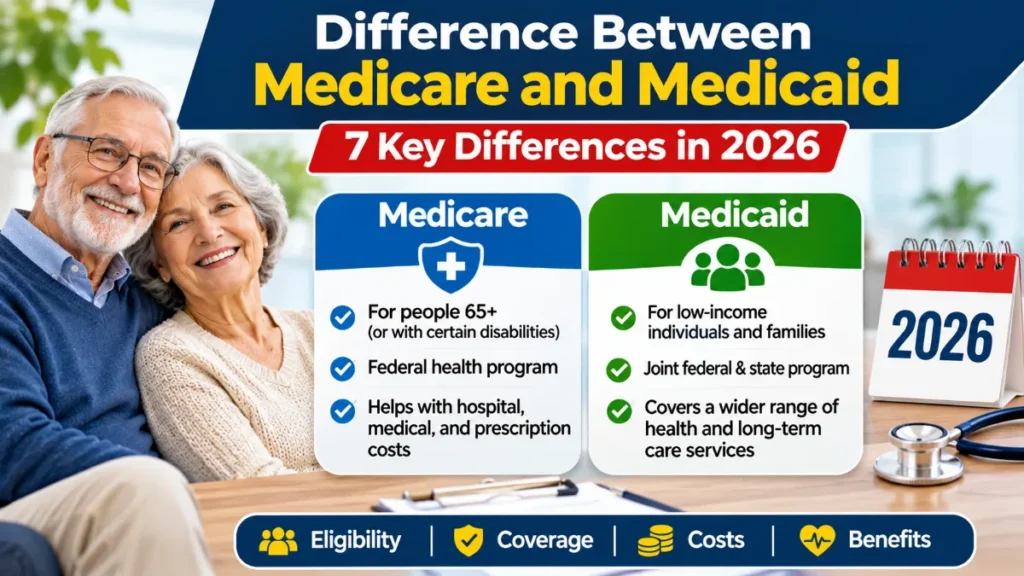
Both Medicare and Medicaid are federally funded healthcare programs however they differ in who can enroll in each program and how those enrolled will be covered. Medicare is a federal healthcare program specifically designed for individuals aged 65 and over as well as some individuals younger than 65 who have a disability or qualifying medical condition. Medicaid is a jointly funded federal/state healthcare program which covers eligible individuals (usually low-income) for their healthcare costs. Many Americans may be eligible for both programs.
Medicare does not have an upper income restriction for individuals to qualify for its services. However, some Medicare recipients with greater income levels will incur higher costs associated with receiving specific types of care. Eligibility for Medicaid is based upon several criteria, including household income, age, disability status, as well as additional criteria which vary from state-to-state.
Medicare vs. Medicaid: Key Differences
Feature
Medicare
Medicaid
Eligibility
Primarily based on age or qualifying disabilities and medical conditions
Based on income and other state-specific requirements
Age requirements
Generally 65 or older, with exceptions
Available to eligible people of all ages
Income limits
No general income ceiling for eligibility
Limits vary by state and eligibility category
Coverage
Hospital care, medical services, prescription drugs, and other eligible benefits
Medical services, preventive care, and qualifying long-term care
Costs
Premiums, deductibles, and coinsurance may apply
Generally free or low-cost for eligible beneficiaries
Funding
Federal funding includes payroll taxes, general revenues, and beneficiary premiums.
Joint federal and state funding
Administration
Federally administered, with private plans and contractors participating
State-administered under federal requirements
While both of these programs assist American citizens with obtaining medical care, there are significant differences between them regarding eligibility requirements, the types of health care provided, and whether or not a person will have to contribute financially for their own health care.
Who Qualifies for Medicare and Medicaid?
Medicare Eligibility
Most Americans can qualify for Medicare as early as age 65 if they have met either of the two qualifying criteria – either US citizenship or legal residency in the United States.
People younger than 65 may also qualify if they:
Receive qualifying Social Security disability benefits.
Have amyotrophic lateral sclerosis (ALS), also known as Lou Gehrig’s disease.
You must have End Stage Renal Disease (ESRD) and qualify for Medicare based on your condition.
People who are eligible for disability benefits usually have to wait two years (24 months) for their Medicare coverage to start. However, if you are diagnosed with ALS or ESRD, there are some other regulations that will be used to determine when your Medicare coverage can begin.
There is no maximum income level that determines whether you can enroll in Medicare. However, if your income is above a certain amount, you may be required to pay more for your Medicare Part B and Part D coverage.
Medicaid Eligibility
The people who qualify for Medicaid are those with low incomes, such as children (if they meet the criteria), pregnant women, parents of qualifying children, older adults, individuals with disabilities, and additional eligible adults.
Unlike Medicare, which has a single set of eligibility guidelines for all states, each U.S. state determines its own criteria for who qualifies for Medicaid. There are many different types of individuals and families that may be eligible for Medicaid; some qualify primarily based upon their family’s income while others have other criteria such as meeting asset limitations or being subject to additional eligibility requirements.
Medicaid expansion generally provides insurance coverage to eligible adults aged 19-64 who have a household income at or below 138% of the federal poverty level. States that choose to participate in Medicaid expansion will generally offer this type of coverage. However, not all states have chosen to expand Medicaid.
Because of the differences in how the rules are applied, a person who is eligible for Medicaid in one state may not be eligible for Medicaid in another state. The Federal Government has set forth a framework for determining who qualifies for Medicaid, but each state determines eligibility based upon its own approved program.
What Do Medicare and Medicaid Cover?
Both programs provide essential medical care, but their organization of benefits differs. Medicare provides coverage through several distinct parts, whereas Medicaid offers benefits through state-run programs that are compliant with federal standards.
Medicare Coverage: Parts A, B, C, and D
Medicare has four main parts:
Part A (Hospital Insurance): This part helps pay for covered hospitalizations, skilled nursing facility stays, hospice services, and some types of home health care.
Part B: (Medicare Insurance) provides coverage for physician visits, outpatient treatments, preventative service, durable medical equipment, and other necessary medical care.
Part C (Medicare Advantage): Offers a different option than Original Medicare by utilizing Medicare-approved private insurance plans. Most of these plans include Part A and Part B, many include Part D coverage and others can provide additional benefits.
Part D (Prescription Drug Coverage): This part of Medicare helps pay for certain types of outpatient prescription drugs using a Medicare drug plan.
The basic part of Medicare consists of Part A and Part B. Depending upon the individual’s health care requirements and the option for joining, he/she may select either Original Medicare or Medicare Advantage. To learn about the functioning of both parts, refer to the official Medicare coverage overview.
Routine dental care is a key area to consider. While Original Medicare generally will not pay for routine cleanings, fillings and/or dentures, there are times when routine dental care can be provided by Original Medicare if it’s tied to an illness that’s being treated medically. Also, some Medicare Advantage plans provide extra routine dental care as a benefit. The formal rules of routine dental care provided by Medicare are available through the “Medicare Dental Coverage Rules” page.
Medicaid Coverage
Medicaid pays for many different types of health care, including hospitalization, doctor appointments, lab tests, and preventive care.
Depending on the state and eligibility category, coverage may include:
Medicaid covers most outpatient prescription drugs; however, there are many differences between states in terms of formulary development and coverage rules.
States have a great deal of latitude when deciding which dental services are covered for adults. All states must provide dental care to children who qualify for Medicaid as per federal guidelines.
Nursing Facility Care: Medicaid can assist with paying for eligible nursing facility care (long-term).
In addition to receiving care in a hospital setting, eligible beneficiaries can also receive their needed long-term services and support either in their own home or within a community.
A critical difference between Medicare and Medicaid relates to long-term personal care. In general, Medicare will not pay for custodial care services (i.e., help with hygiene, getting dressed, etc.) as long as professional medical care is not necessary. Medicaid may provide payment for such services if individuals qualify.
Medicare vs. Medicaid Costs in 2026
Generally speaking, those receiving Medicare benefits will have greater direct health care costs than individuals who are eligible for complete Medicaid coverage.
For 2026, the standard Original Medicare costs are:
Medicare expense
2026 amount
Part A monthly premium
$0 for most eligible beneficiaries
Part A inpatient hospital deductible
$1,736 per benefit period
Standard Part B monthly premium
$202.90
Part B annual deductible
$283
Typical Part B coinsurance
20% of the Medicare-approved amount after the deductible
Beneficiaries, for the most part, will not need to pay a premium for Part A due to either having enough Medicare-covered work experience themselves or through an eligible spouse. If someone is required to pay for Part A, they could be paying anywhere from $311 up to $565 each month during 2026 based upon individual situations.
Medicare Advantage plans and Medicare Part D plans have different levels of cost to beneficiaries. Original Medicare does not usually have an annual out-of-pocket maximum on covered Part A and Part B benefits unless the beneficiary has additional coverage that provides such limits.
These amounts reflect the official 2026 Medicare premiums and deductibles.
Medicaid usually has lower out of pocket costs than other health insurance programs. A majority of Medicaid beneficiaries will have to pay little to nothing for their health care services that are covered by Medicaid; however, there are times when some Medicaid beneficiaries may be required to pay for premiums and/or copays based upon each states’ regulations and the person’s eligibility status.
The actual cost will vary based upon which services are provided, what type of plan has been set up for payment, and the individual’s specific situation.
Can You Have Medicare and Medicaid at the Same Time?
Yes, people who meet the requirements for both programs are eligible to receive both Medicare and Medicaid. These people have what’s called “dual eligibility.”
Medicare usually provides initial coverage for Medicare-eligible health care. Following Medicare (and other primary insurance) payments, Medicaid will pay according to Medicaid guidelines.
Individuals who are covered by full Medicaid will have their Medicare costs (such as premiums, deductibles, and co-insurance) as well as some of the services that Medicare doesn’t pay for, subsidized.
Medicare prescription drug coverage functions slightly differently than other types of health insurance. Those who are enrolled in both Medicare and have Medicaid benefits typically receive their outpatient prescription drug benefit via Medicare. However, Medicaid can provide benefits for certain drugs that are not covered by Medicare based on individual state regulations.
The official guidance regarding coordination of Medicare and Medicaid explains the relationship between the two programs.
Medicare Savings Programs
Medicare savings programs may allow individuals who meet eligibility criteria (i.e., have low income/assets) to decrease their health-care costs.
The Qualified Medicare Beneficiary (QMB) program helps cover the cost of your Medicare Part A and Part B premiums as well as other Medicare-covered costs such as deductibles, co-insurance, and copayments.
Eligible people can receive financial assistance for their Part B premiums through the Specified Low Income Medicare Beneficiary (SLMB) program.
QI – Qualify Individual – This program will pay for a portion of the Part B premium for individuals that qualify for the program.
People who have full Medicaid coverage can also get assistance for eligible long term service and support. Those people are typically eligible to receive “Extra Help” to pay for Medicare Prescription Drugs.
However, receiving help from a Medicare Savings Program does not automatically make someone eligible to receive complete Medicaid benefits.
How to Apply for Medicare or Medicaid
Since Medicare and Medicaid use two separate processes to apply, it will depend on what type of assistance you require as to where you should begin.
Applying for Medicare
Most individuals who are approaching the age of 65 will have an Initial Enrollment Period (IEP) which lasts for seven months. The seven-month period starts three months prior to the month of the individual’s 65th birthday, continues throughout the month of the individual’s 65th birthday, and ends three months after the month of the individual’s 65th birthday.
A few individuals may be automatically enrolled into a program, whereas many other individuals will need to submit an application.
To get started:
Visit the medicare website (medicare.gov) for information about eligibility criteria, types of coverage available, and when you can enroll.
To apply for Medicare Parts A and B, you can do so through the Social Security Administration at SSA.gov. This process can be completed if enrollment has not already occurred automatically.
Compare medicare advantage and prescription drug plans when you need additional coverage.
Missing an appropriate enrollment deadline can cause a delay in when you receive your coverage, or a penalty for signing up after the due date. In some cases, a Special Enrollment Period (SEP) may apply.
Applying for Medicaid
Unlike Medicare, Medicaid generally accepts applications throughout the year.
To apply:
Visit Medicaid.gov to find your state’s Medicaid agency.
Review the income limits and eligibility requirements that will be applied to your household.
You may apply for benefits using either your state’s Medicaid system, or some other approved method of applying for benefits.
The provided requested information will include income, household members, residency status, and any other qualifying factor.
Medicaid eligibility is typically determined by the appropriate State agency.
Medicaid Eligibility Changes Coming in 2027
The new federal Medicaid community engagement requirements will be effective for some adult Medicaid beneficiaries who have been enrolled in Medicaid via the Affordable Care Act’s (ACA) Medicaid expansion or other similar eligibility pathways starting January 1, 2027. However, states can choose to implement these requirements prior to January 1, 2027.
Adults affected by the law must generally complete some type of qualifying activity (i.e. employment, school, community service). Typically, the law has a monthly minimum of 80 hours, as well as additional ways to qualify and/or exceptions.
These requirements do not apply to all Medicaid recipients. The exception includes some Medicaid recipients (Medicare recipients) as well as several additional groups.
Because of the importance of how a program is implemented, those who could potentially be impacted by the changes in Medicaid need to review their state’s eligibility and reporting guidelines. The federal government’s information regarding the implementation of the new community engagement requirements for Medicaid will provide further insight.
Read also: Dentist Salary in 2026: Average Pay, Specialties, and Career Outlook
Frequently Asked Questions
1. Can you qualify for Medicaid if you already have Medicare?
Yes. Having Medicare does not prevent you from qualifying for Medicaid. If you meet your state’s income, resource, and other eligibility requirements, you may receive benefits from both programs. Medicaid can help pay certain Medicare expenses and provide additional covered services.
2. Does Medicaid automatically end when you turn 65?
No. Turning 65 does not automatically end Medicaid coverage. However, your state may review your eligibility under different rules for older adults, including applicable income and asset limits. If you continue to qualify, you may keep Medicaid while also receiving Medicare.
3. Can you get Medicare at 65 if you have never worked?
Yes. You may qualify for Medicare at 65 without your own employment history if you meet the applicable citizenship or residency requirements. However, you might have to pay a monthly Part A premium unless you qualify for premium-free coverage through a spouse’s work history or another eligible pathway.
4. Is Medicaid better than Medicare for long-term nursing home care?
Medicaid generally provides broader coverage for qualifying long-term nursing home care. Medicare mainly covers eligible short-term skilled nursing facility services and does not ordinarily pay for ongoing custodial care. Medicaid coverage still depends on financial, medical, and other applicable eligibility requirements.
5. Does Medicaid cover healthcare in every state?
Medicaid operates in all 50 U.S. states, but coverage rules, benefits, and participating providers vary. If you move to another state, your existing Medicaid eligibility does not automatically transfer. You generally need to apply for coverage under your new state’s program.