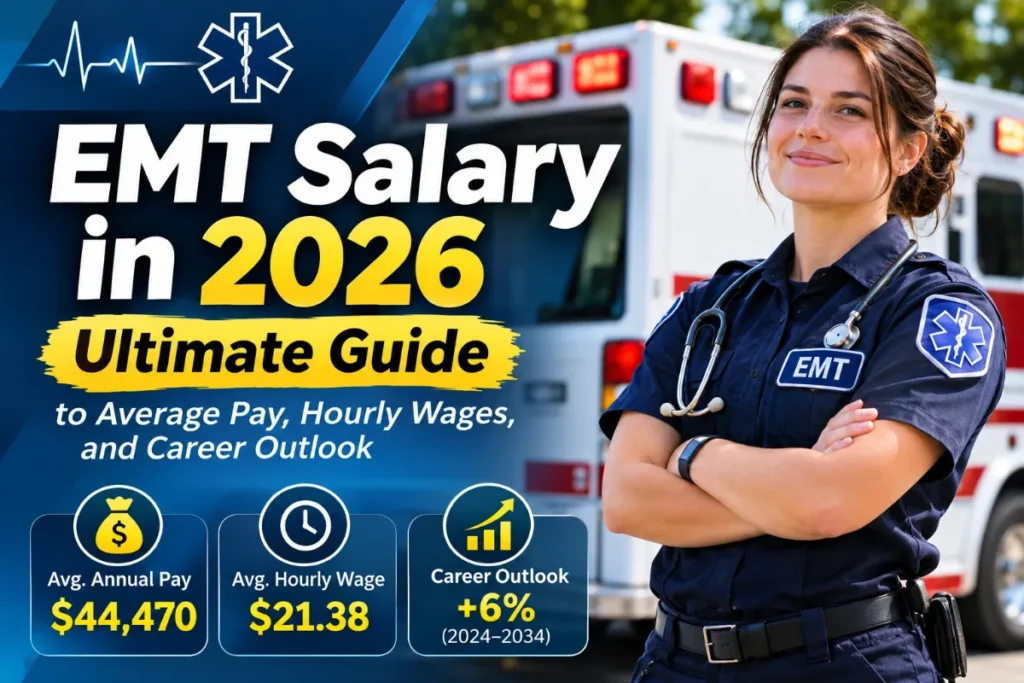
The median EMT salary in the United States is $44,470 per year, or $21.38 per hour, according to the latest available wage data from the U.S. Bureau of Labor Statistics (BLS), based on May 2025 employment figures. The lowest-paid 10% of emergency medical technicians earn less than $34,130 annually, while the highest-paid 10% earn more than $62,500.
EMT pay varies depending on location, experience, employer, shift schedule, and additional qualifications. Emergency medical technicians working in hospitals, ambulance services, and government agencies may receive different compensation packages.
Understanding these differences can help new EMTs evaluate job offers, compare career opportunities, and plan for higher-paying positions.
How Much Does an EMT Make in 2026?
Median annual salary
$44,470
Median hourly wage
$21.38
Source: BLS, May 2025 wage data, the latest available for 2026.
Bureau of Labor Statistics+1
The BLS reports separate wage figures for EMTs and paramedics. This distinction matters because paramedics generally complete more advanced training and earn higher salaries.
According to the official BLS EMTs and Paramedics Occupational Outlook Handbook, the median annual salary for EMTs was $44,470 in May 2025.
EMT Salary by Earnings Percentile
| Earnings level | Annual salary | Hourly wage |
| 10th percentile | $34,130 | $16.41 |
| 25th percentile | $37,960 | $18.25 |
| Median (50th percentile) | $44,470 | $21.38 |
| 75th percentile | $50,100 | $24.09 |
| 90th percentile | $62,500 | $30.05 |
BLS May 2025 national wage estimates for emergency medical technicians. Percentiles describe the distribution of earnings, not guaranteed salaries for particular experience levels.
wages.fyi+1
An EMT earning near the 10th percentile is toward the lower end of the national wage distribution, while someone earning near the 90th percentile receives substantially higher compensation.
However, these figures do not indicate how much a particular employer will offer a newly certified EMT.
Average EMT Salary vs. Median EMT Salary
Although the terms average salary and median salary are often used interchangeably, they represent different calculations.
The average, or mean, salary is calculated by dividing total earnings by the number of workers. The median identifies the midpoint of the wage distribution.
For May 2025, the BLS reported:
- Average EMT salary: $46,830 annually.
- Median EMT salary: $44,470 annually.
- Average hourly wage: $22.52.
- Median hourly wage: $21.38.
The median is often more helpful when assessing typical earnings because unusually high salaries can increase the average.
For someone considering an EMT career, the median provides a useful starting point, while local wage figures offer a more specific comparison.
2025 A01 Results
EMT Salary by State
An EMT’s geographic location can significantly affect earnings.
States and metropolitan areas have different wage levels because of differences in living costs, employer demand, funding, workforce availability, and local labor conditions.
For example, the following median salaries were reported in the May 2025 wage data:
| State | Median annual EMT salary | Median hourly pay |
| Maine | $46,340 | $22.28 |
| Ohio | $40,220 | $19.34 |
| Utah | $38,930 | $18.72 |
| West Virginia | $34,360 | $16.52 |
These examples illustrate why the national median should not be treated as the expected salary in every state.
CareerOneStop+1
Which States Pay EMTs the Most?
Some states offer higher average or median wages than others, but the highest-paying location is not necessarily the best financial choice.
For instance, higher housing expenses, transportation costs, and state taxes may offset some of the benefits of increased pay.
Before relocating, compare:
- Local EMT salary estimates.
- Housing and transportation costs.
- Available full-time positions.
- Overtime policies and shift schedules.
- Healthcare coverage and retirement benefits.
- State certification and licensing requirements.
The U.S. Department of Labor’s CareerOneStop Salary Finder allows workers to compare wages by occupation and geographic location.
This is more useful than relying on generalized salary rankings when evaluating a specific state or city.
EMT Salary by Workplace
The type of organization employing an EMT can make a substantial difference in pay.
Emergency medical technicians work in ambulance companies, hospitals, outpatient facilities, government departments, and other medical settings.
The BLS reports the following median salaries for EMTs in selected industries.
| Workplace | Median annual EMT salary |
| Outpatient care centers | $67,560 |
| Private general medical and surgical hospitals | $47,160 |
| Local government, excluding education and hospitals | $45,780 |
| Ambulance services | $42,260 |
| Local government general medical and surgical hospitals | $41,650 |
Source: BLS, May 2025. These are industry medians rather than starting salaries or guaranteed offers.
Bureau of Labor Statistics
Ambulance Services
Ambulance companies are among the most recognizable EMT employers.
EMTs working in these settings may respond to emergency calls, provide basic medical care, and transport patients to healthcare facilities.
Schedules often involve evenings, weekends, holidays, and extended shifts.
The median EMT salary in ambulance services was $42,260 annually in May 2025.
Hospitals
Hospitals employ EMTs in roles that may involve emergency departments, patient transport, or other clinical support responsibilities permitted by state law and employer policies.
Private general medical and surgical hospitals reported a median EMT wage of $47,160.
Specific duties and compensation depend on the facility and position.
Government Agencies
Government-employed EMTs may work for municipal emergency medical services or other public agencies.
Some positions include benefits such as retirement plans, paid leave, and employer-sponsored health insurance.
However, benefits vary widely between departments, and not every government EMT position offers the same compensation package.
Outpatient Care Centers
EMTs employed in outpatient care centers had a relatively high industry median of $67,560.
This figure should not be interpreted as the standard salary for every outpatient EMT position. Employment arrangements, responsibilities, and local labor markets can affect compensation.
EMT Salary by Experience Level
Experience can influence an EMT’s earnings, but higher pay is not automatic. Salary progression depends on employer pay scales, individual performance, union agreements, and available promotions.
Entry-Level EMT Salary
Newly certified EMTs often begin in lower-paying positions while gaining practical experience.
The BLS reports that the lowest-paid 10% of EMTs earned less than $34,130 annually in May 2025.
However, this is not an official entry-level salary figure. The group includes workers of different experience levels and employment circumstances.
New EMTs should review local job postings and compare hourly wages before accepting their first position.
Experienced EMT Salary
Experienced EMTs may qualify for higher-paying opportunities by developing strong patient-care skills, maintaining certifications, and gaining experience in demanding emergency medical environments.
Some experienced workers also pursue supervisory or training responsibilities.
The highest-paid 10% of EMTs earned more than $62,500 annually, but reaching this level depends on several factors beyond years of service.
Advanced EMT Salary
An Advanced EMT, or AEMT, has training beyond the standard EMT level and may perform additional emergency medical procedures within the limits of applicable state rules.
The National Registry’s AEMT certification guidance describes the additional clinical responsibilities associated with this level.
Advanced qualifications may improve employment opportunities, but they do not guarantee a particular salary increase.
The national BLS salary figures discussed here do not provide a separate wage distribution for AEMTs.
EMT vs. Paramedic Salary: Which Pays More?
Paramedics generally earn more than EMTs because they complete additional education and are trained to provide more advanced emergency medical care.
Median Annual Salary: EMT vs. Paramedic
United States, May 2025
020,00040,00060,000$80,000EMTParamedic
Source: U.S. Bureau of Labor Statistics, May 2025.
Bureau of Labor Statistics
| Comparison | EMT | Paramedic |
| Median annual salary | $44,470 | $60,600 |
| Median hourly salary | $21.38 | Approximately $29.13 |
| Training | EMT education program | More extensive paramedic program |
| Main responsibilities | Basic emergency medical care | Basic and advanced emergency medical care |
| State license required | Yes | Yes |
The median paramedic salary is $16,130 higher than the median EMT salary, a difference of approximately 36%.
Nevertheless, the additional education and training required for paramedic certification involve time and expenses that prospective students should consider.
For workers interested in advancing their emergency medical careers, becoming a paramedic is one potential path toward higher earning opportunities.
Does Overtime Increase EMT Salary?
Overtime can increase an EMT’s total earnings, particularly in organizations that schedule long shifts or provide opportunities to cover additional hours.
EMTs may work 12-hour or 24-hour shifts, depending on the employer. Some positions also require weekend, overnight, or holiday availability.
The BLS Occupational Employment and Wage Statistics estimates exclude overtime premiums and certain other compensation, so an employee’s actual annual earnings may exceed the published wage estimate.
For example, an EMT earning $21 per hour would receive $840 in gross regular wages for a 40-hour workweek. If that employee worked five qualifying overtime hours at time-and-a-half, those additional hours would produce $157.50 in gross overtime pay.
This is an illustration, not a national overtime-pay estimate. Eligibility, rates, and compensation rules depend on applicable employment laws and employer policies.
For additional details, see the BLS Occupational Employment and Wage Statistics FAQs.
What Benefits Do EMTs Receive?
In addition to hourly wages or annual salaries, some employers provide benefits that increase the overall value of an EMT’s compensation package.
Common examples include health insurance, dental and vision coverage, retirement plans, paid time off, tuition assistance, and paid continuing education.
Government agencies and larger healthcare organizations may offer structured benefits packages, although specific coverage depends on the employer and employment status.
When comparing offers, consider the entire package rather than looking at the base wage alone.
For example, a position paying slightly less per hour may offer better healthcare coverage, more paid leave, or stronger retirement contributions.
How to Become an EMT in the United States
Becoming an EMT requires completing appropriate education and meeting applicable certification and state licensing requirements.
The process generally involves several steps.
1. Complete an Approved EMT Training Program
Prospective EMTs must complete a state-approved education program that meets the applicable emergency medical services education standards.
Programs typically cover patient assessment, emergency response, airway management, CPR, trauma care, and ambulance operations.
The length and cost of training vary by institution and state.
2. Meet Certification Requirements
Many states use National Registry certification as part of their licensing process.
The National Registry’s EMT pathway requires completion of an approved program, passing the certification examination, and meeting the state-approved basic life support skills competency requirement.
Candidates can review the official National Registry EMT education and certification requirements before enrolling.
3. Obtain State Licensure
Every state requires EMTs to meet its licensing requirements.
National Registry certification and state licensure are related but separate credentials. Requirements may include background screening, additional documentation, and other state-specific conditions.
Always check with the relevant state EMS office for current instructions.
4. Apply for EMT Positions
After meeting applicable requirements, candidates may apply for positions with ambulance companies, hospitals, and government emergency medical services.
Employers may also require a valid driver’s license, physical capability testing, background checks, or additional training.
How Can EMTs Increase Their Salary?
EMTs who want to improve their earning potential can consider several career-development strategies.
- Gain relevant experience: Build clinical skills and a dependable work record that may qualify you for higher-paying positions.
- Compare employers: Review compensation at hospitals, ambulance providers, and government agencies rather than assuming pay is similar everywhere.
- Pursue advanced training: Consider AEMT or paramedic education when it aligns with your career goals and state requirements.
- Explore specialized opportunities: Seek positions that require additional training or responsibilities and offer appropriate compensation.
- Review overtime opportunities: Understand the pay structure and avoid schedules that create excessive fatigue.
- Consider leadership roles: Experienced EMTs may pursue positions in training, operations, or supervision if they meet the qualifications.
Salary growth usually requires balancing additional training costs, job responsibilities, and personal career interests.
EMT Job Outlook: Is It a Good Career in 2026?
Employment prospects for EMTs remain positive according to current federal projections.
The BLS projects 6% employment growth for EMTs and paramedics between 2025 and 2035, faster than the projected average for all occupations.
The agency expects continued demand for emergency medical services due to medical emergencies, injuries, and an aging population.
Bureau of Labor Statistics
However, employment growth does not guarantee that every location will have the same number of openings or salary opportunities.
Advantages of an EMT Career
Working as an EMT provides opportunities to deliver emergency medical care, develop hands-on clinical skills, and enter healthcare without completing a four-year degree.
It may also serve as a foundation for further education in emergency medicine, nursing, or other healthcare fields.
Challenges of Working as an EMT
The profession can be physically and emotionally demanding.
EMTs regularly encounter emergency situations, challenging environments, and patients requiring urgent assistance.
Shift work, irregular schedules, and the possibility of overnight duty can also affect work-life balance.
For someone evaluating the profession, these considerations are just as important as salary.
Is Becoming an EMT Worth It?
Becoming an EMT can be a worthwhile career choice for people who want hands-on patient care and are comfortable working in unpredictable emergency environments.
The median salary of $44,470 provides a useful national benchmark, but individual earnings vary considerably.
Prospective EMTs should compare training expenses, local job availability, employer benefits, and opportunities for advancement.
Those seeking higher long-term earning potential may eventually pursue paramedic certification or additional healthcare qualifications.
The best decision depends on financial priorities, professional interests, and the type of work someone wants to perform.
Read also: Dopamine Patches: Uses, Benefits, Side Effects, and Do They Work?
Frequently Asked Questions
1. How much does an EMT make per hour in 2026?
The median EMT hourly wage is $21.38, based on BLS May 2025 data. Actual wages vary by location, employer, qualifications, and other factors.
2. What is the average EMT salary per year?
The average annual EMT salary is $46,830, while the median is $44,470. Both figures come from BLS wage estimates for May 2025.
3. How much does an entry-level EMT make?
Entry-level pay varies by employer and location. The lowest-paid 10% of EMTs earn less than $34,130 annually, but this figure is not an official starting salary.
4. Can EMTs make $60,000 a year?
Yes. The highest-paid 10% of EMTs earn more than $62,500 annually. However, that level of compensation is not typical for every EMT position.
5. Do EMTs get paid more than paramedics?
Generally, no. The national median salary for EMTs is $44,470, compared with $60,600 for paramedics, according to BLS May 2025 figures.
6. Do hospital EMTs make more money?
Some hospital EMT positions pay more than ambulance-based roles. In May 2025, private general medical and surgical hospitals reported a median EMT salary of $47,160, compared with $42,260 in ambulance services.
7. How much do EMTs make a month?
An annual salary of $44,470 is equivalent to approximately $3,706 per month before taxes and deductions. This is a mathematical conversion of the national median, not a separately reported monthly wage.
8. How long does it take to become an EMT?
EMT training often takes several months, but the precise timeline depends on the program, course schedule, certification process, and state licensing requirements.
9. Is EMT a good-paying job?
EMT pay may be sufficient for some workers, depending on local living expenses and household needs. Its national median is below the median for all U.S. occupations, so prospective EMTs should carefully consider local compensation and advancement opportunities.
10. Will EMT salaries increase in the future?
EMT wages may change with labor demand, inflation, collective bargaining agreements, and employer budgets. The BLS projects employment growth, but that does not guarantee any particular future salary increase.
Final Thoughts
The EMT salary in 2026 has a national median of $44,470 annually, based on the latest available BLS wage data. Actual compensation varies significantly by employer, location, experience, and work schedule.
EMTs looking for higher earnings can explore hospital and government positions, advanced certifications, and paramedic training.
For anyone considering this career, the strongest approach is to compare local salaries, understand licensing requirements, and evaluate long-term advancement opportunities before enrolling in a training program.